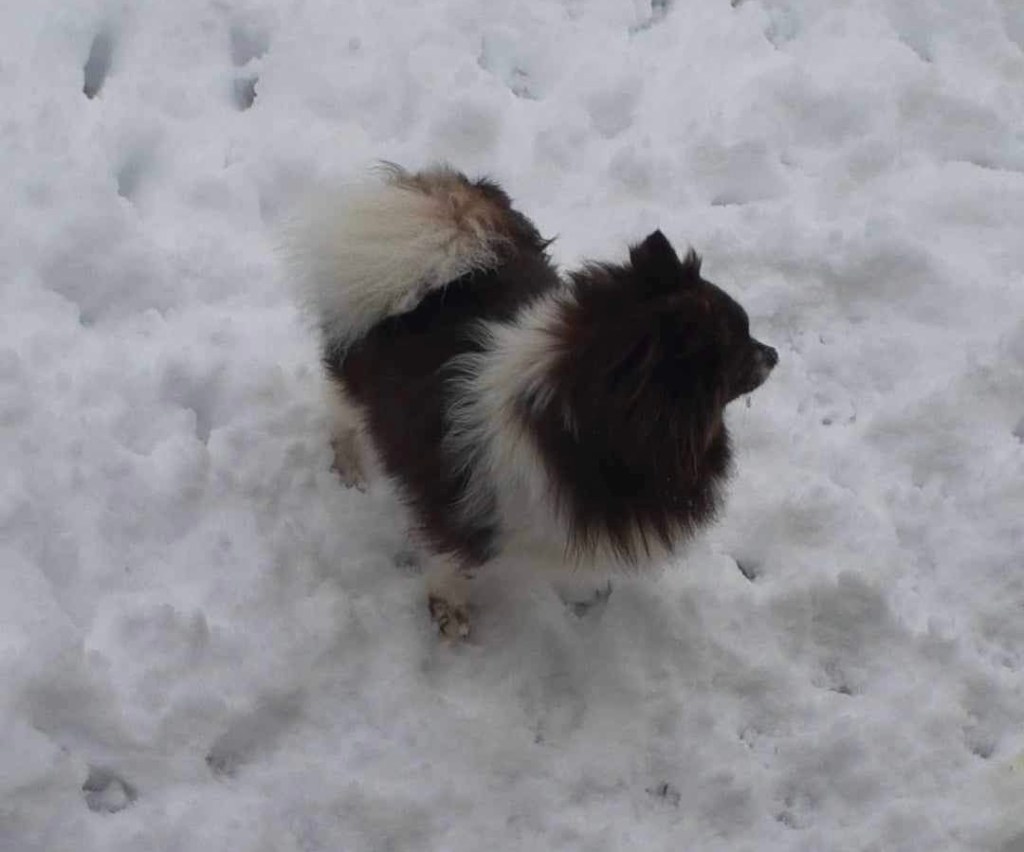
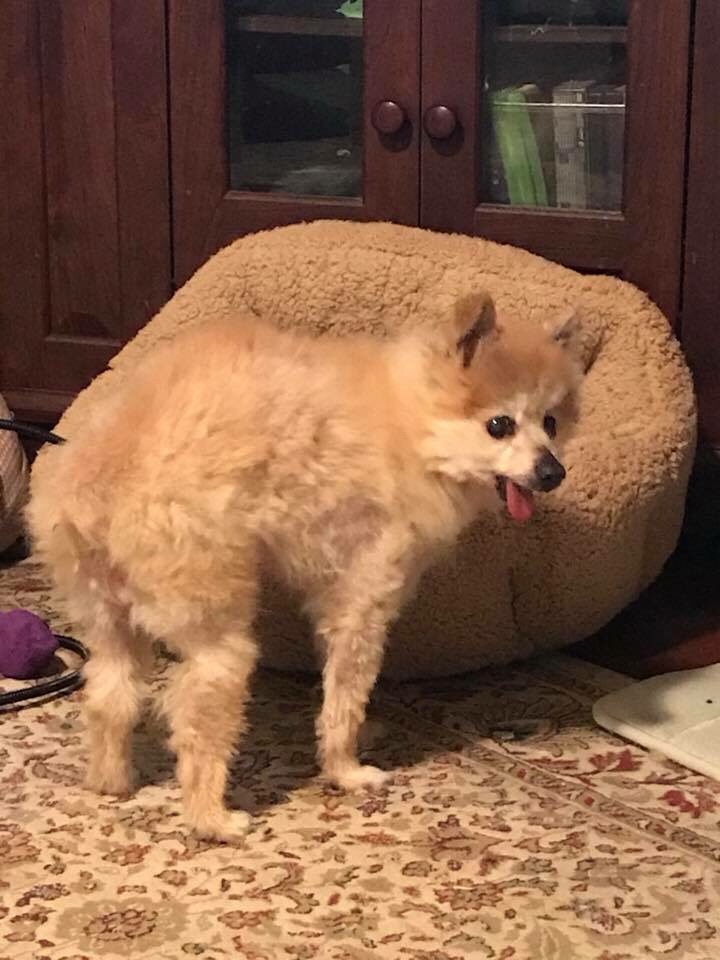
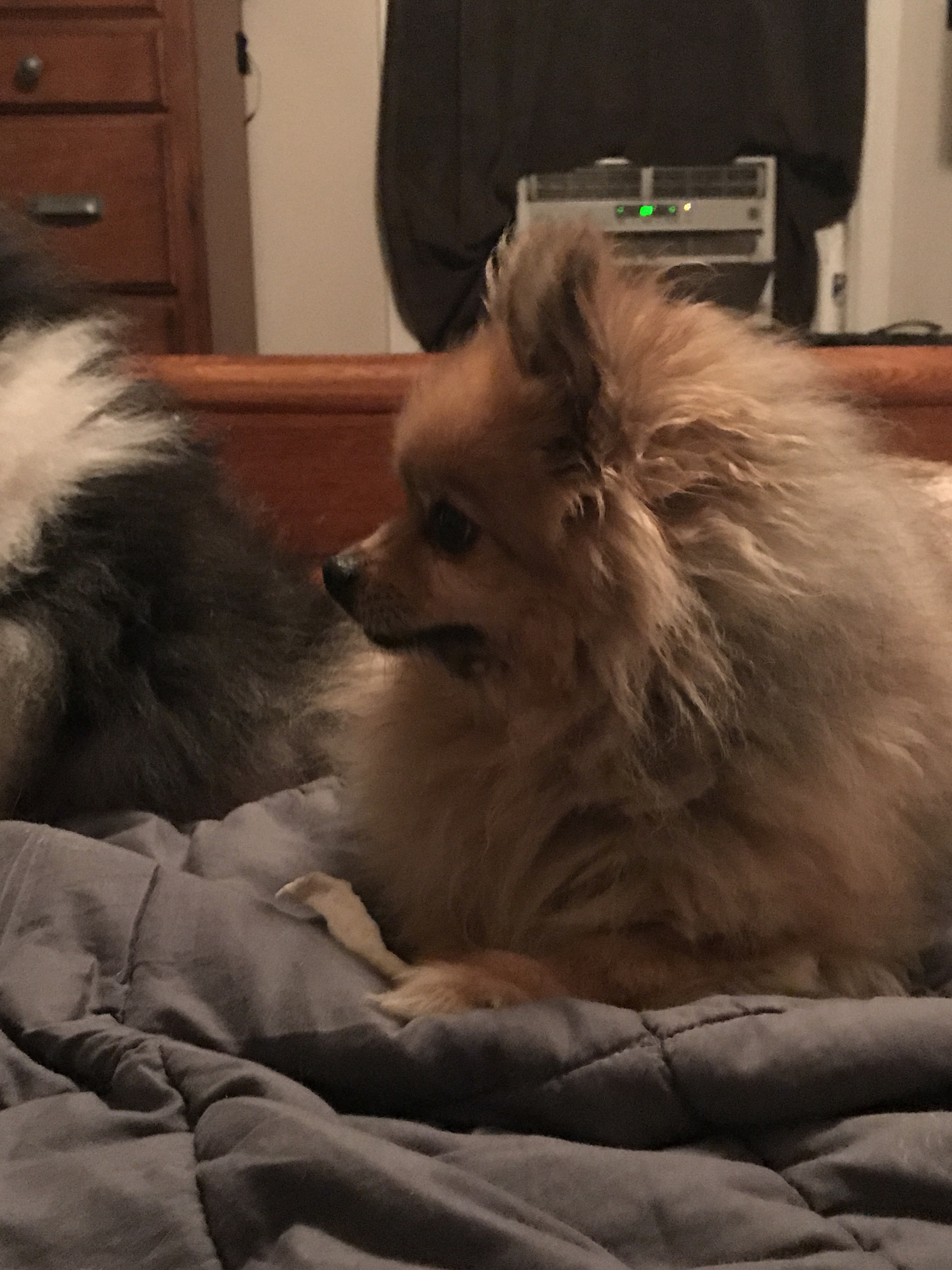
The Pomeranian Club of Central Virginia, Inc (PCCV) is a 501(c)(3), non-profit organization. The PCCV is a licensed American Kennel Club (AKC) local specialty club based in Virginia. Our parent club is The American Pomeranian Club (APC).
Some things are better left unsaid. No matter how good something might sound to you—before you utter it aloud—there are some basic “no no’s” when it comes to talking with a dog mom or dog dad. Here are 7 definite comments you should never tell a dog parent. See how many of these have been hurled your way.
“You Have Dogs Because You Don’t Have Kids, Right?”
Not only is this rude, but there are millions of people who enjoy both varieties of kids: both the human and the canine types. If you are someone who chooses to have children and then look down upon me or any other millions of childless by choice folks with a sneer, think twice before you speak. We are not lesser people for not having human children. In fact, many of us feel much richer by being graced by the presence of a dog.
“Oh, Your Dog Died? Well, Get Another One!”
Though I said “never again” to allowing a dog to enter my life and thus my heart, exactly 30 days after losing my dog in 2008, I did bring another dog into my life. I know I could never not love this way again. For millions of us, hearing “just get another one” when a dog dies is insensitive and can be interpreted as downright cruel, no matter how well-intentioned your words might seem. We do not replace people when they pass, and dog parents feel the same way: A life is irreplaceable no matter the form it takes.
“Dogs Should Not Be Allowed on Furniture/Bed”
To everyone whose name graces my birth certificate other than myself, I say “shhhh.” According to a survey conducted by the American Pet Products Association, almost half of dogs sleep with their owners in their owner’s beds. Until you walk a mile in someone else’s shoes, where their dog is allowed to reside is totally their own business. Besides, some of us sleep better, feel calm, and are generally more positive people with a dog by our side, present company included.
“That Dog Doesn’t Understand What You’re Saying”
I talk to my dog. Raise a paw if you are one of the millions of people who talks to their canine family member(s). I do this whether I am doing laundry, shopping in a pet-welcoming store, or driving in the car. Maybe he doesn’t understand “Mommy needs a new pair of pumps” but he knows the intonation of my voice and responds with a tail wag and a tilted head; or sometimes no reaction at all. Dogs are living, breathing beings, and it is a fact that much of what we say is understood. Just ask Chaser, the dog who knows well over 1,000 words. To each their own, and if talking to my dog bothers you then don’t eavesdrop.
“That Dog Should Be Put Down; He’s Costing You Too Much Money”
Perhaps one of the most unsavory and disturbing trends involves folks who feel they are the mortality police. The decision to euthanize a beloved pet is a very personal and heartbreaking one. I know because I’ve been down that road. Telling me to put a dog down in the name of cost savings is grounds for dismissal from my life, and I know I am not alone in feeling this way.
“You Shouldn’t Let that Dog Kiss You”
My mouth, my face, my dog, my life: These four factors alone are all reasons why dog kisses are allowed. Yes, there is a whole scientific school of thought, and some fact, about germs and bacteria and cross contamination and zoonotic diseases. If you don’t want a smooch from my pooch if I am getting a dog kiss, look away and say nothing.
“You Are Welcome, But the Dog Is Not”
As someone who has traveled the country with dogs for over 20 years, my mantra is “love me, love my dog.” I do not expect dogs to be allowed everywhere and anywhere, but I do expect the welcome mat to be rolled out if I want to bring my well-behaved dog with me to certain things. Granted, I know my dog can’t come to your wedding or to someone’s funeral, though I’ve seen pooches at both. If you simply do not want my dog at your house because you just aren’t all that into dogs, then sorry: I’m just not all that into you.
Of the 319 bones, on average, that comprise a dog’s skeleton, a handful of those (so to speak) are dedicated to the paws. Along with bones, dog feet include skin, tendons, ligaments, blood supply, and connective tissue.
2. Paws Have Five Parts
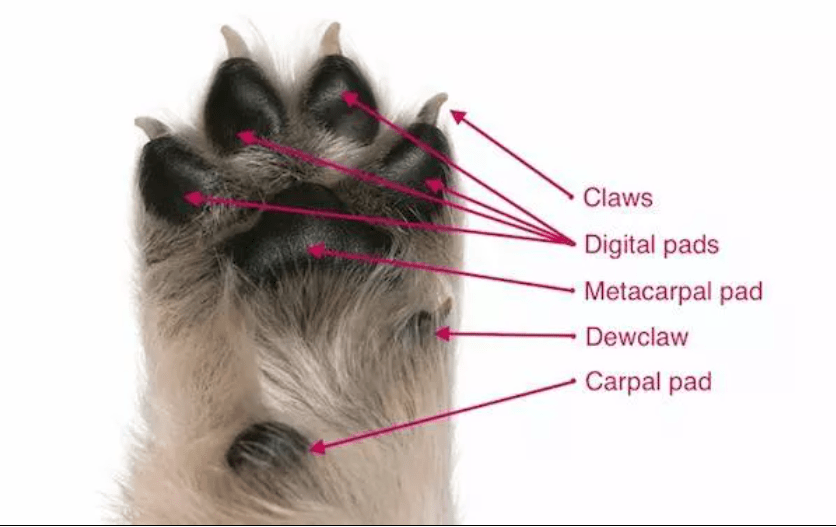
Paws are made up of the following five components: Claws, digital pads, metacarpal pads, dewclaws, and carpal pads, as illustrated below.
Illustrated with the paw of a 4-week-old puppy.
Eric Isselee / Shutterstock / Treehugger
Pads
3. The digital and metacarpal pads work as shock absorbers and help protect the bones and joints in the foot. The carpal pads kind of work like brakes, and help he dog navigate slippery or steep slopes.
4. Paw pads have a thick layer of fatty tissue, but that doesn’t mean your pooch can’t sustain an injury from walking on a surface that’s too hot or cold.1 Scientists believe that domestic dogs first evolved in colder environments before spreading out into other climates.2 The thick pads allow dogs to develop a tolerance to temperature extremes. However, in cold weather, dogs can suffer from cracked or bleeding paws and in hot weather, walking on hot sand or sidewalks can cause their paws to blister.
5. The pads also offer protection when walking on rough terrain.3 Dogs that are outside a lot and exposed to rough surfaces have thicker, rougher paw skin; dogs that stay in more and walk on smoother surfaces have softer pads. The pads also help the dog distinguish between different types of terrain.
mikroman6 / Getty Images
6. The inner layer of skin on the paw has sweat glands, though they are not effective in cooling a dog on a hot day. You might notice paw prints as your dog’s paws exude moisture; dogs get sweaty hands, just like humans do.
Toes
7. Dogs are digitigrade animals, meaning that their digits—not their heels—take most of their weight when they walk.4 Because of this, dogs’ toe bones are very important.
8. Dog’s toes are equivalent to human’s fingers and toes, although they are unable to wiggle them with the ease that we do.
Dewclaws
9. Dewclaws are thought to be vestiges of thumbs.1 Dogs almost always have dewclaws on the front legs and occasionally on the back. Front dewclaws have bone and muscle in them, but in many breeds, the back dewclaws have little of either. Because of this, dewclaws are often removed to prevent them from getting snagged. (However, opinions on the necessity of this procedure are mixed.)
10. Although they don’t provide very much function for traction and digging, dogs do use their dewclaws; they help the dog get a better grip on bones and other things the dog may like to chew on. Front dewclaws also provide traction when dogs are running at high speeds.
11. Great Pyrenees still use their rear dewclaws for stability on rough, uneven terrain and often have double dewclaws on the hind legs. Among show dogs, the Beauceron breed standard is for double rear dewclaws; the Pyrenean shepherd, briard, and Spanish mastiff are other breeds that have double rear dewclaws listed for show standards as well.
Shape and Size
12. Breeds from cold climes, like St. Bernards and Newfoundlands, have wonderfully large paws with greater surface areas. Their big, floppy paws are no accident; they help these breeds better tread on snow and ice.
13. Newfoundlands and Labrador retrievers are known for their long toes. Both breeds also have webbed feet, which helps make them excellent swimmers. Other breeds with webbed feet include the Chesapeake Bay retriever, Portuguese water dog, field Spaniel, and German wirehaired pointer.
14. Some breeds have what are called “cat feet.” These dogs have a short third digital bone, resulting in a compact feline-like foot; this design uses less energy to lift and increases the dog’s endurance. You can tell by the dog’s paw print: the prints of cat feet are round and compact. Akita, Doberman pinscher, giant schnauzer, Kuvasz, Newfoundland, Airedale terrier, bull terrier, keeshond, Finnish spitz, and Old English sheepdog all have cat feet.
15. On the other hand — er, paw — some breeds have “hare feet,” which are elongated with the two middle toes longer than the outer toes. Breeds that enjoy hare feet include some toy breeds, as well as the Samoyed, Bedlington terrier, Skye terrier, borzoi, and greyhound. Their paw prints are more slender and elongated.
Paw Odor
16. And then there’s “Frito feet.” If you notice the distinct smell of corn chips emanating from your dog’s paws, resist salivating. Sometimes the aroma is due to bacteria and fungi, but generally, the odor doesn’t lead to complications for the dog.
Massage
17. Do you love having your hands massaged? So does your pup. A paw massage can relax your dog and promote better circulation. Try rubbing between the pads on the bottom of the paw, and then rubbing between each toe.
Etymology
18. “Paw” comes from the early 14th-century paue, meaning “hand or foot of an animal which has nails or claws,” from Old French powe, poue, poe “paw, fist,” a word of uncertain origin.
Pet odors in the home can be more than just unpleasant—they can pose health risks if not properly managed. For instance, pet waste can release ammonia into the air, which can trigger respiratory issues and irritation in humans, and in high concentrations, may even lead to illness.
To avoid these risks, it’s essential to monitor your pet’s activities and clean up any accidents as soon as they happen. Using enzymatic cleaners specifically designed for pet messes is key, as they break down odor-causing compounds effectively.
Additionally, pet dander can lead to allergic reactions in sensitive individuals. Maintaining good hygiene and cleanliness in the home, including regular cleaning of high-traffic pet areas, can help minimize both odors and potential health hazards.
Here are some tips to help keep your home fresh and free from pet odors and bacteria:
Remove Odors: Odors can be a cause of health problems. The human olfactory system has the responsibility of detecting odors.
Biological Pollutants in Your Home: Pet dander can be a source of biological pollutants. Some people have sensitivities to biological pollutants, and they may have an allergic reaction.
How to Clean Up Cat Urine: When cat urine comes into contact with a household surface, it’s important to clean up the mess quickly. If odors persist after cleaning an area, it may be necessary to resurface or replace materials.
Pet Stains: Cleaning up pet stains within an hour or two of occurrence should be enough to resolve the stain and odor. Applying sunlight and air circulation to a stain can also help resolve it.
Odors: What’s That Smell? (PDF): It may be possible to neutralize odors in bedding by sprinkling the area with baking soda. Allow the baking soda to sit on the fabric for several hours, then vacuum it.
Baking Soda: The Everyday Miracle (PDF): Baking soda neutralizes odor molecules to stop unpleasant smells. Baking soda is also a natural and safe substance, making it ideal for sprinkling on a pet’s bed to control odors.
What to Do if Your Dog Soils the House: When pets make messes in the house, you must clean up the mess thoroughly to prevent issues. An enzymatic cleaner will break down molecules to remove them completely from a surface.
Help Yourself to a Healthy Home (PDF): Restricting pets from living areas and bedrooms can help if family members have problems with asthma or allergies. This restriction will help eliminate pet dander from these areas.
The Indoor Cat Initiative (PDF): Cats may intentionally mark their territory with urine spray. If this occurs, you will need to clean up the mess thoroughly to prevent lingering odors.
Bathing Your Dog: Dogs need regular bathing to minimize odors, which they can transfer to surroundings in a home.
Asthma Triggers (PDF): Cats, dogs, birds, and rodents can produce allergens that enter the air and incite an allergic response in some people. Improper cleaning in a home may lead to an excess of dander and odors, which can make allergies worse.
Dangers of Dog Poop: Failure to clean up dog feces can lead to contamination and illness. Parasites are often present in dog feces, which can transfer to humans to cause illness.
Five Important Reasons to Clean Up Pet Waste: Cleaning up and disposing of pet waste is one of the tasks of pet ownership. Allowing waste to accumulate without disposing of it can lead to unpleasant odors and illness.
Ammonia Fact Sheet: Allowing pet waste to fester without cleaning it can lead to the release of ammonia into the air. Ammonia has a strong and unpleasant odor. Exposure to ammonia can lead to health issues.
Indoor Air Issues: Ammonia (PDF): Ammonia is colorless, but it has a strong odor. Pet urine contains ammonia. Exposure to ammonia in an enclosed area can cause irritation of the throat, eyes, and nose. Headaches may also occur.
What Is Ammonia? Ammonia occurs naturally in some types of bacteria, including pet urine. People may notice exposure to ammonia with symptoms such as burning eyes, nose, and throat.
Removing Pet Stains and Odors (PDF): Finding the source of pet odors can be challenging. Using a black light may enable you to find old urine stains.
Successful Cleaning to Remove Pet Odors and Stains (PDF): Steam cleaners can be counterproductive when cleaning urine stains from upholstery and carpet. The heat from the steam may actually set in the odor and the stain instead of removing them.
Removing Pet Stains and Odors: Cleaning pet stains with products containing ammonia or vinegar will mask the odors instead of removing them. An enzymatic cleaner should effectively remove both stains and odors.
Cleaning Tips: Failure to clean up urine completely may lead to future problems. Even if you cannot smell urine, a pet probably can. The pet may make additional messes in the same area because urine odors persist.
Owning a Cat: A dirty litter box may lead a cat to urinate inappropriately in the home. If a cat feels threatened, it may also urinate outside of the litter box to mark its territory.
Creature Comforts: Assess potential litter box issues if a cat has problems with inappropriate urination. Placing the litter box in a location where a cat feels uncomfortable might cause the cat to refuse to use it.
Cat Behavior Tips (PDF): A cat may have a health problem if it does not use a litter box correctly. Have a cat evaluated by a veterinarian if indiscriminate urination occurs.
Urine Spraying (PDF): Neutering a male cat is an effective way to stop urine spraying in the home. Always clean up urine messes quickly and thoroughly to avoid lingering pet odor.
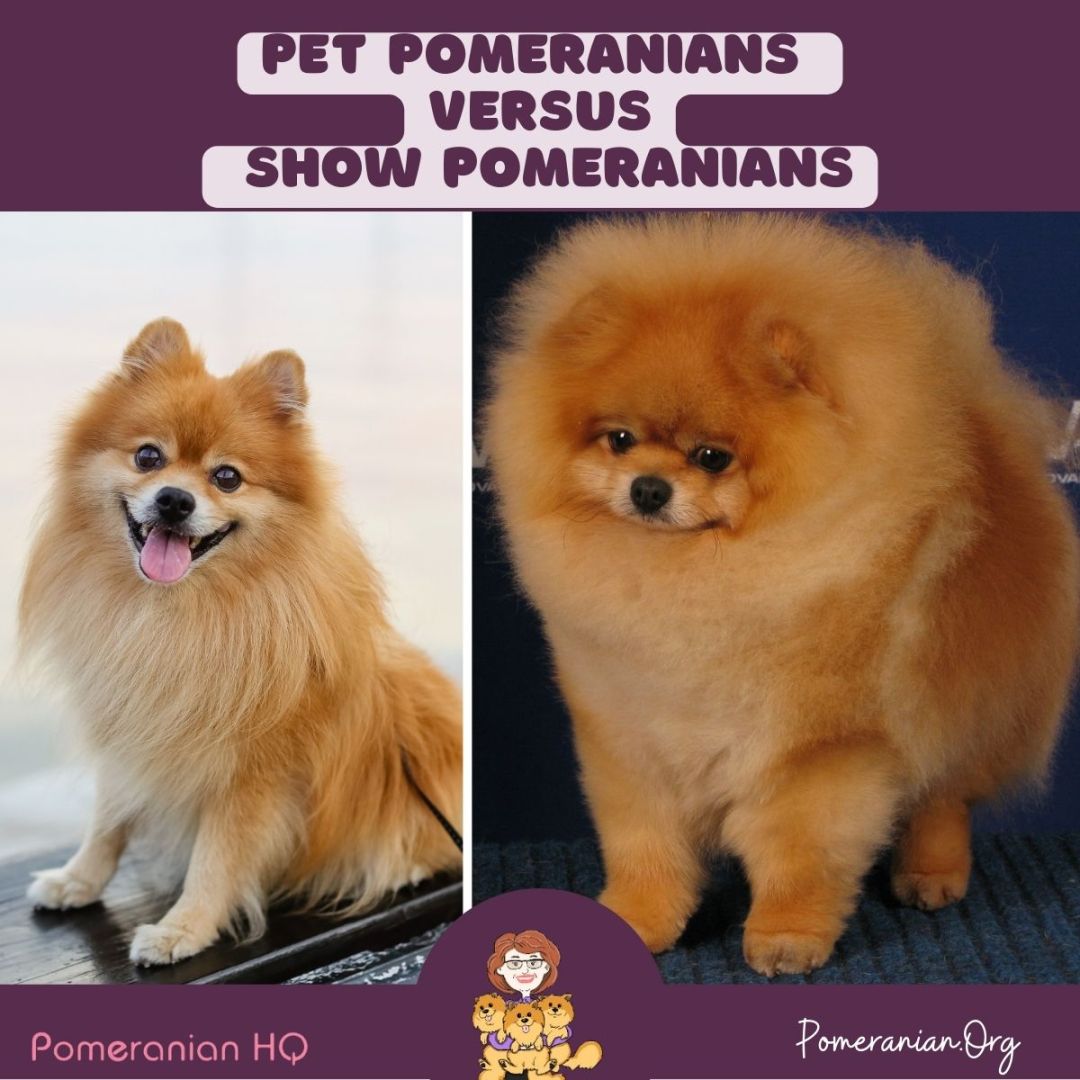
Why Do Show Pomeranians and Pet Pomeranians Look Different? Pomeranians are known for their showmanship, and the Poms, in particular, take pride in this. They prance around proudly at dog shows, but how do they differ from pet Pomeranians?
How Does A Breeder Determine The Difference Between A Pet And A Show Dog?
Pomeranian show dog breeders try to select the best specimens to breed with. For example, a Pom breeder will decide, after doing everything required, which dogs meet the Pomeranian Breed standard and which don’t.
Even very small problems such as a curly tail or a tooth out of line mean he’s better suited to being a Pomeranian pet or companion. If a Pom puppy is designated as a show prospect, this means he has no discernible flaws.
What is this horking, harfing, hocking mess? Hairball?
Reverse sneezing in dogs can be alarming if you’ve never experienced it before. But, luckily, it’s not quite as scary as it sounds.
Reverse sneezing occurs primarily in dogs and much less frequently in cats. Here’s what you need to know about reverse dog sneezing and what you can do to help stop it.
What Is Reverse Sneezing in Dogs?
Reverse sneezing, or an inward sneeze, is a sudden, involuntary respiratory reflex. It occurs when a dog’s soft palate (the soft part on the roof of the mouth that separates the nasal passage from the oral cavity) becomes irritated.
This irritation causes the soft palate muscles to spasm, resulting in a temporary narrowing of the trachea. The dog extends his neck as he expands his chest to breath, but the narrowed trachea makes it difficult for the dog to fully inhale like normal. The dog then repeatedly attempts to inhale through his nose, which results in a snorting noise.
Why Do Dogs Reverse Sneeze?
Dogs most commonly reverse sneeze to expel an irritant from the soft palate or throat. This is similar to how dogs sneeze to remove irritants from their noses. Anything that irritates the soft palate can lead to a reverse sneezing episode, including a blade of grass, pollen, or dirt.
Other causes of soft palate irritation that may result in reverse sneezing include the following:
Elongated soft palate (common in brachycephalic breeds)
Eating or drinking
What Does Reverse Sneezing in Dogs Sound Like?
Reverse sneezing in dogs sounds like the dog is actually inhaling their sneezes, hence the name “reverse sneezing.” It’s a loud, snorting sound that can sometimes sound like a goose honking or be confused with the dog choking.
Average Height: 5 -11 in Average Weight: 3 -7 lbs Average Life Span: 12 -16 yrs Coloring: Nearly any color and color combinations accepted; single, bi- or tri- colors of black, white, sable, orange, cream, apricot, blue. Can be brindle or spotted. Area of Origin: Germany and Poland; Baltic Sea region of Pomerania Similar Breeds: Keeshond, American Eskimo Dog, Finnish Spitz
History and Origin:
The Pomeranian is a descendent of the Icelandic and Lapland (a northern region of Scandinavia and Russia) sled dogs along with its close cousin, the Keeshond. Before popularity in England caused it to be bred down in size, the Pomeranian was an able sheep-herder, weighing up to thirty pounds. Queen Victoria, after receiving a Pomeranian from Italy, loved the breed so much that she wanted a small, companion-sized version, and initiated the breeding program that reduced the Poms size by up to twenty five pounds. The breed flourished in Britain once the queen showed interest in it, and it soon found its way into the hearts of North Americans; it was recognized by the American Kennel Club in 1888.
Personality and Temperament:
Active and intelligent, the Pomeranian is a loyal breed and extremely loving to its family. It is curious and bold; despite its size, it is an independent dog that will readily stand its ground against much larger animals. The Pomeranian is extremely spirited and alert, excelling in a watch dog position.
Susceptible to Small Dog Syndrome, the Pomeranian needs to be treated as a dog, not a small human, so that it will not try to become the alpha dog of the family. Its friendly nature makes it a good companion for children who are aware of its small size. Suitable for a nervous or first-time owner, the Pomeranian nevertheless needs proper training and socialization to be the best little dog it can be.
Exercise & Training:
While a toy breed, the Pomeranian is an extremely active dog, excelling in agility. A daily walk or jog combined with ample play time will help keep the Pomeranian happy and stimulated, and will help prevent unwanted behavior issues. While it can be a bit yappy, the Pomeranian is suitable for a small home or apartment providing it receives ample exercise. It is an extremely alert and intelligent breed, easily able to pick up on commands quickly. Due to this train-ability, the Pomeranian has frequently been used as a performing dog in circuses.
Grooming:
Possessing a long, frizzy, double coat, the Pomeranian needs daily brushing to remove dead hair and prevent tangling. The undercoat sheds out once or twice a year (depending on the climate in which the Pomeranian lives), and a little extra grooming is ideal to help removed excess fur. Overall, the Pomeranian sheds quite excessively, and is not ideal for allergy sufferers.
Interesting Facts about the Pomeranian:
1. Only three dogs survived the sinking of the Titanic in 1912; two of the three were Pomeranians.
2. The Pomeranian is one of only a handful of breeds that have nearly any coat color; the American Kennel Club accepts 19 coat colorations.
3. President Theodore Roosevelt owned a Pomeranian named Gem.
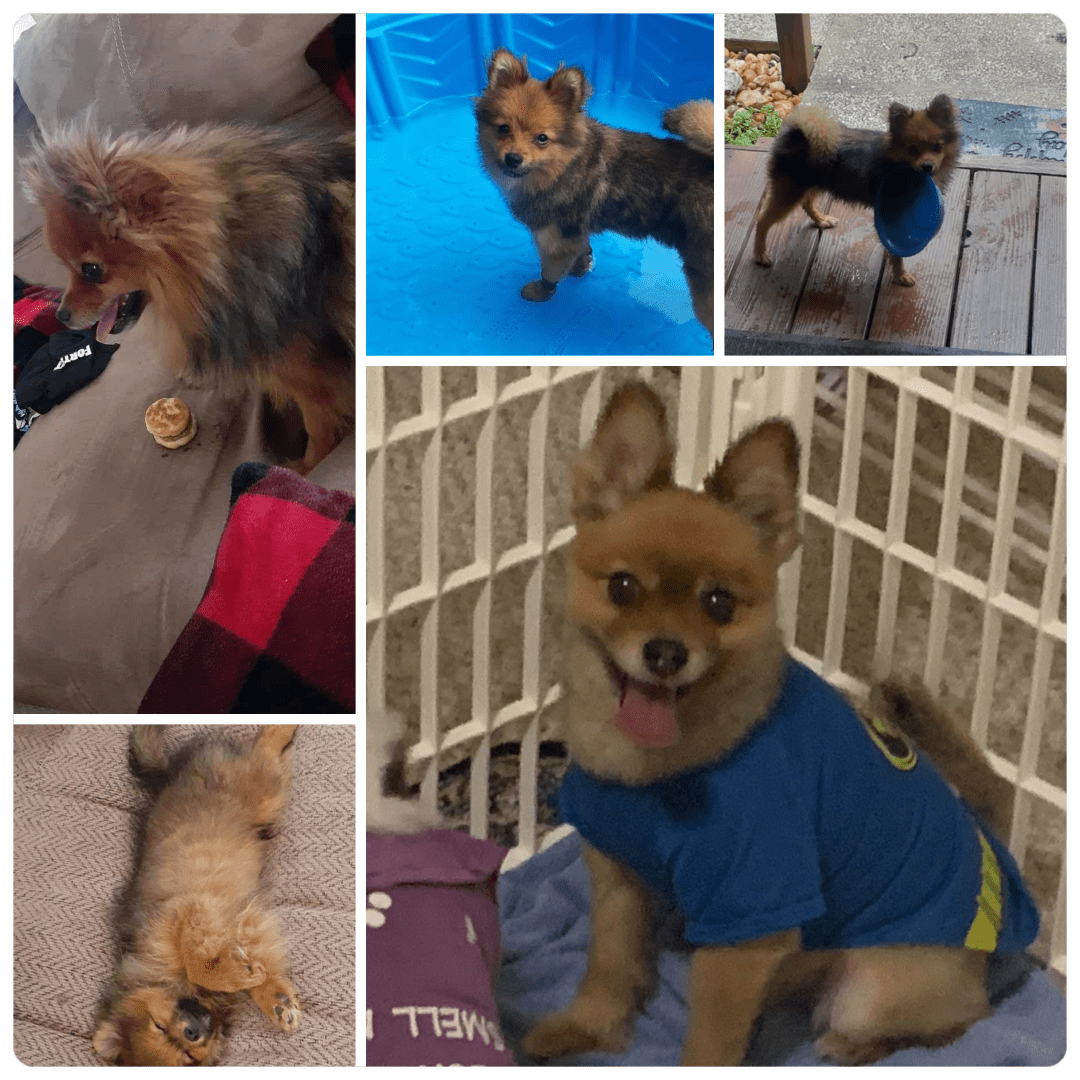
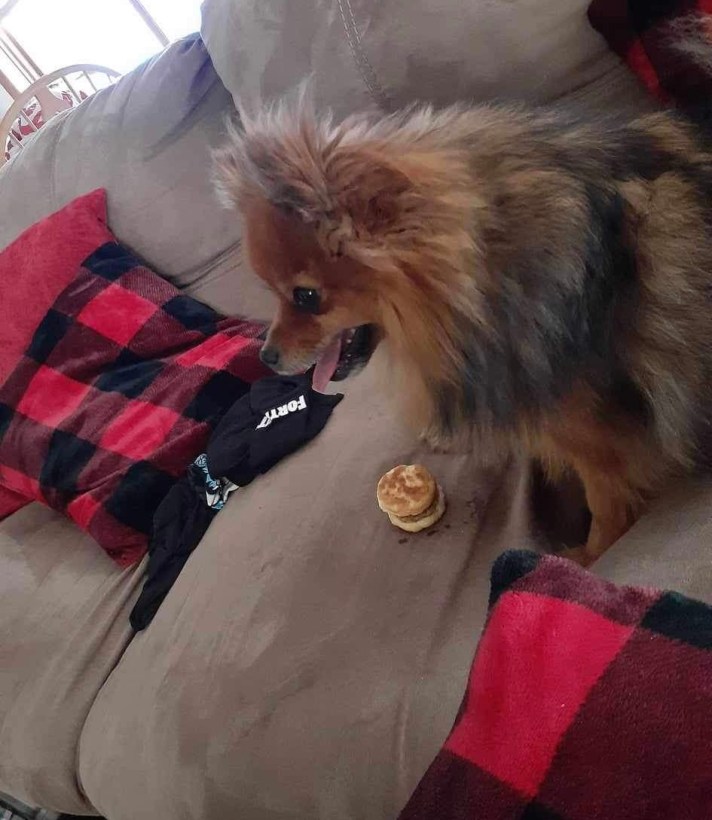
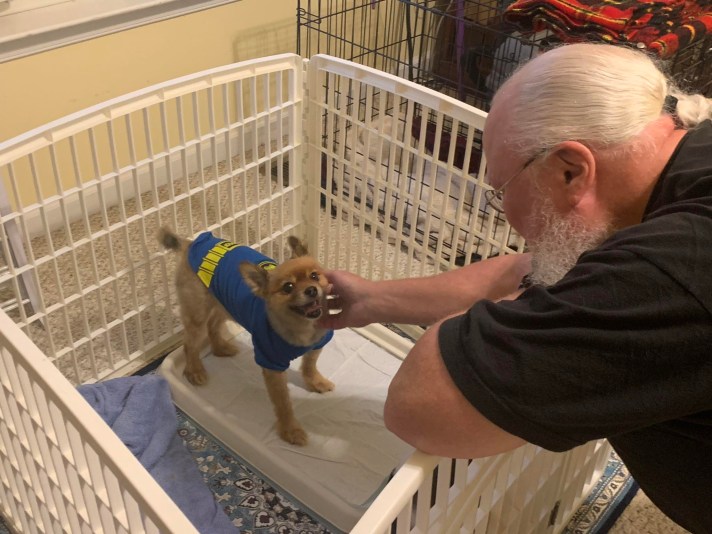
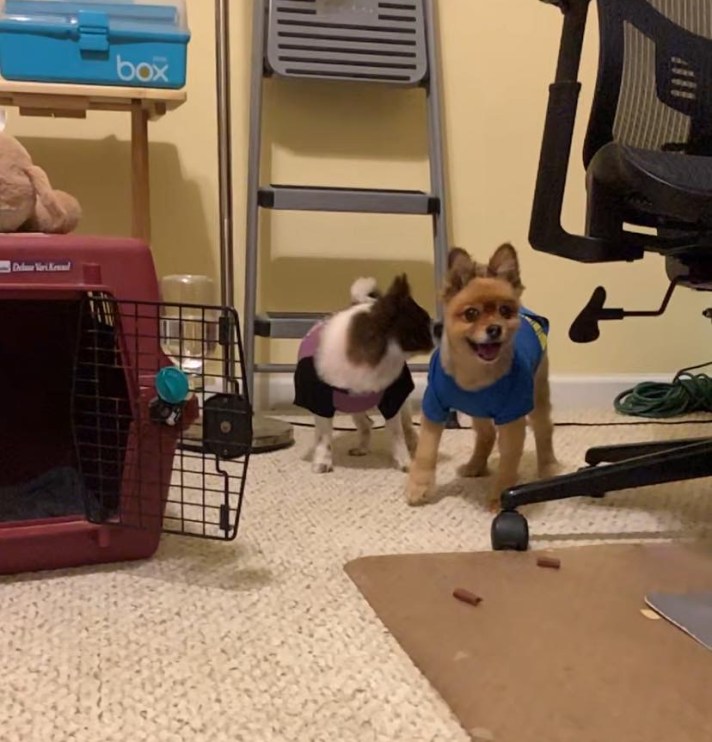
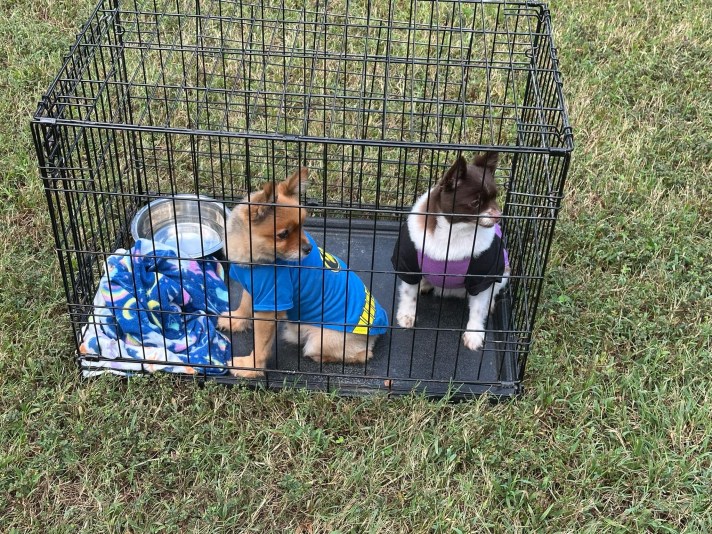
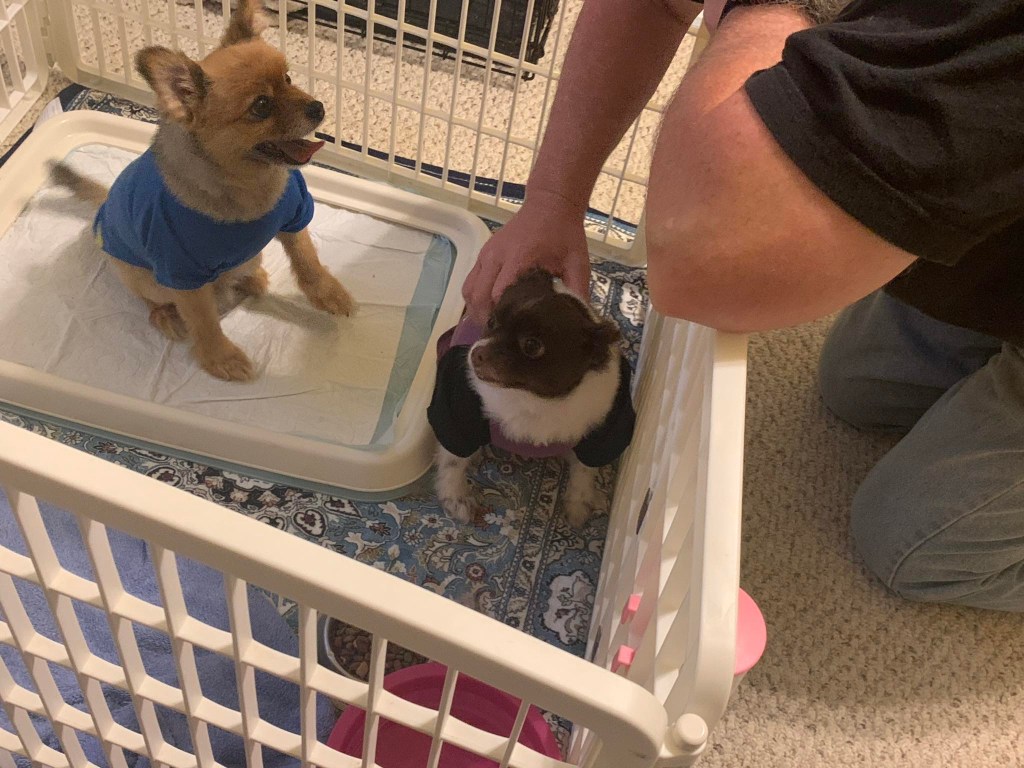
Bear is a very handsome, neutered, red sable Pom. He is very energetic and still has that puppy playfulness. He goes crazy trying to get his sister to play with him, but she mostly ignores him. Please don’t hold his haircut against him, it is growing out!
He is quiet during the day while I’m working and stays in a bed by my desk. He was confused hearing me on a conference call at first and kept barking because he couldn’t find the people talking in the house, but he’s ok now.
He is SUPER playful and has that puppy energy. He made friends quickly with another foster, Demi, and they get pretty rowdy wrestling each other. He is submissive and allowed Demi to be the alpha dog.
He can be sensitive about having the back of his neck touched until he knows you. He nipped us when trying to put a harness off/on. We have been working with him on this and it seems to be a trust issue. We don’t know if something happened to him in the past. He got past it quickly and doesn’t do this to us anymore.
History
He is crate trained.
Bear was surrendered with his sister Truffles. They were acquired during COVID and the son ended up being severely allergic. They tried multiple treatments and methods, but just couldn’t get his allergies under control. The family was devastated by having to make this agonizing decision.
He was shaved down for summer, but it is growing back. You can see in the pictures that he has a gorgeous coat when he is grown in.
What does she need?
Bear should be in a home without young children. His tendency to nip at fingers when surprised by a touch on the back of the neck isn’t good for tiny hands. Especially since the back of the neck is where kids like to pet first.
His family should be a little active to help him work off some of his energy either with walks or rowdy play sessions. He likes to cuddle, but doesn’t sit still for long.
We would love for brother and sister to be adopted together (a discounted adoption rate would apply). However, after evaluation, they are not a bonded pair and can be separated.
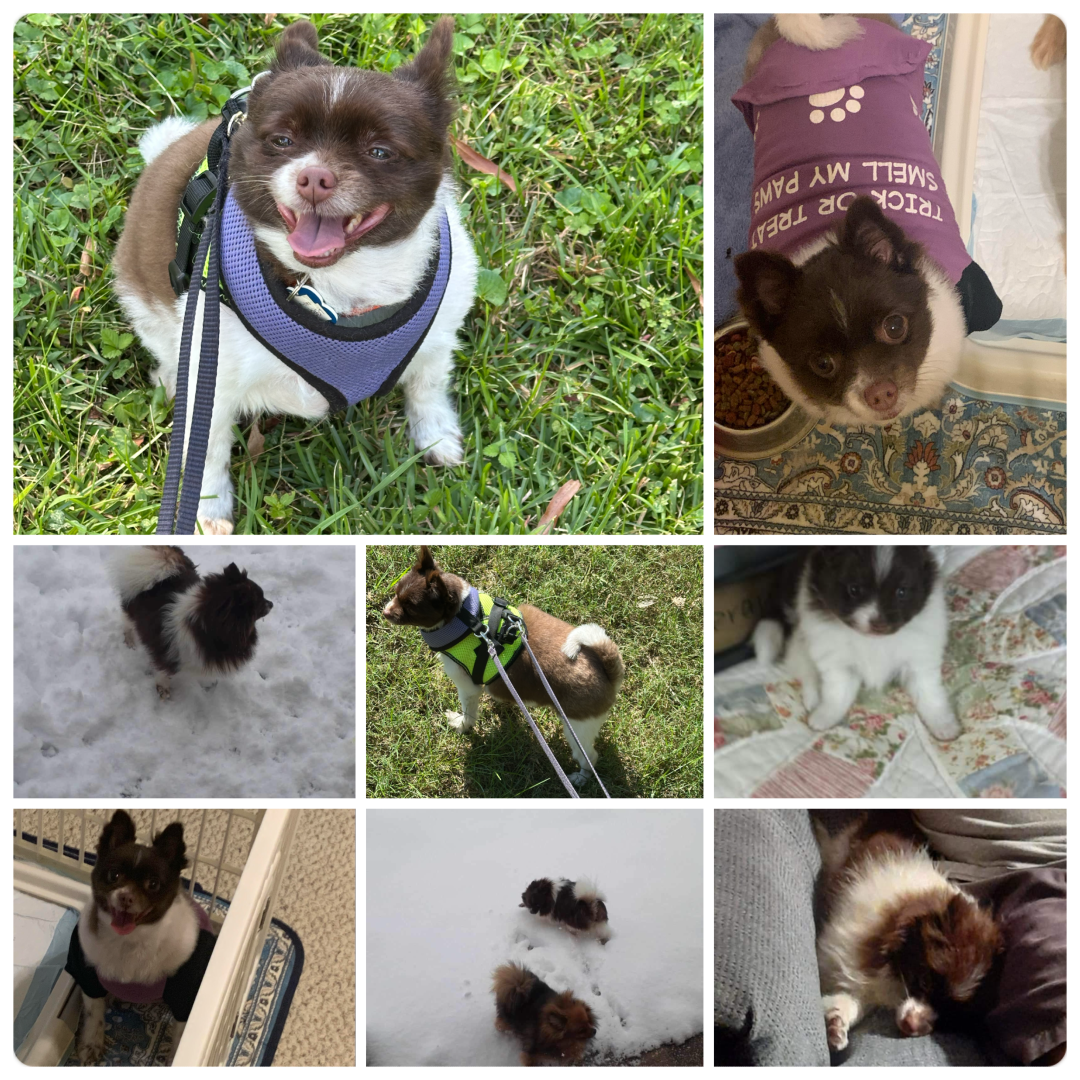
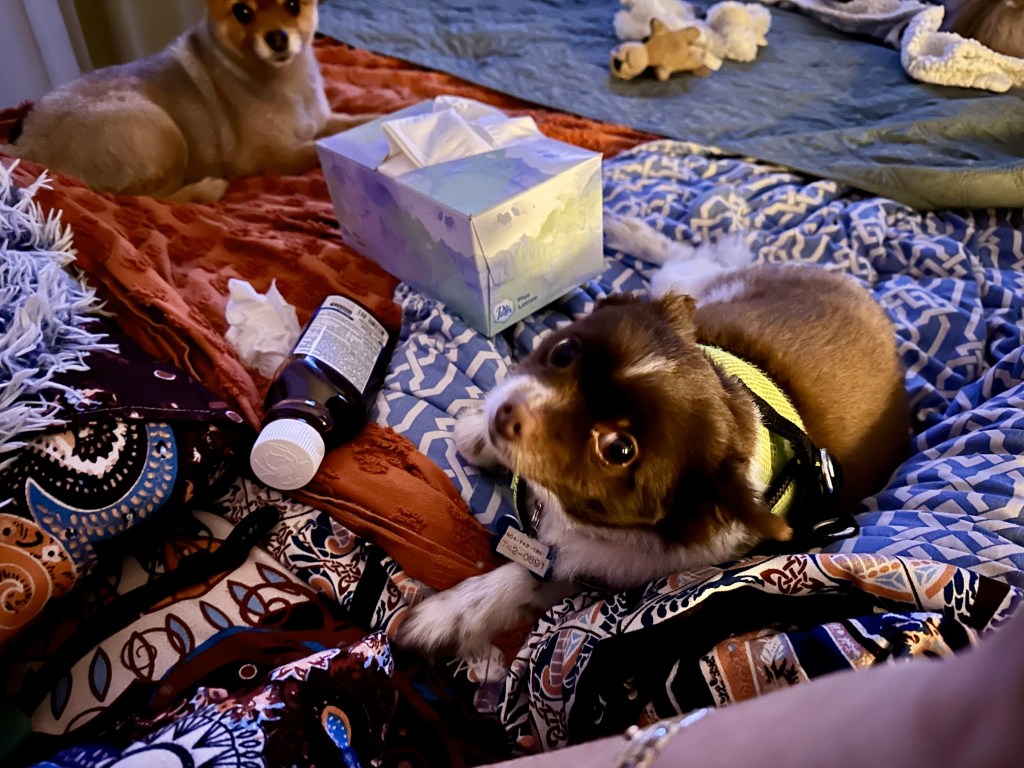
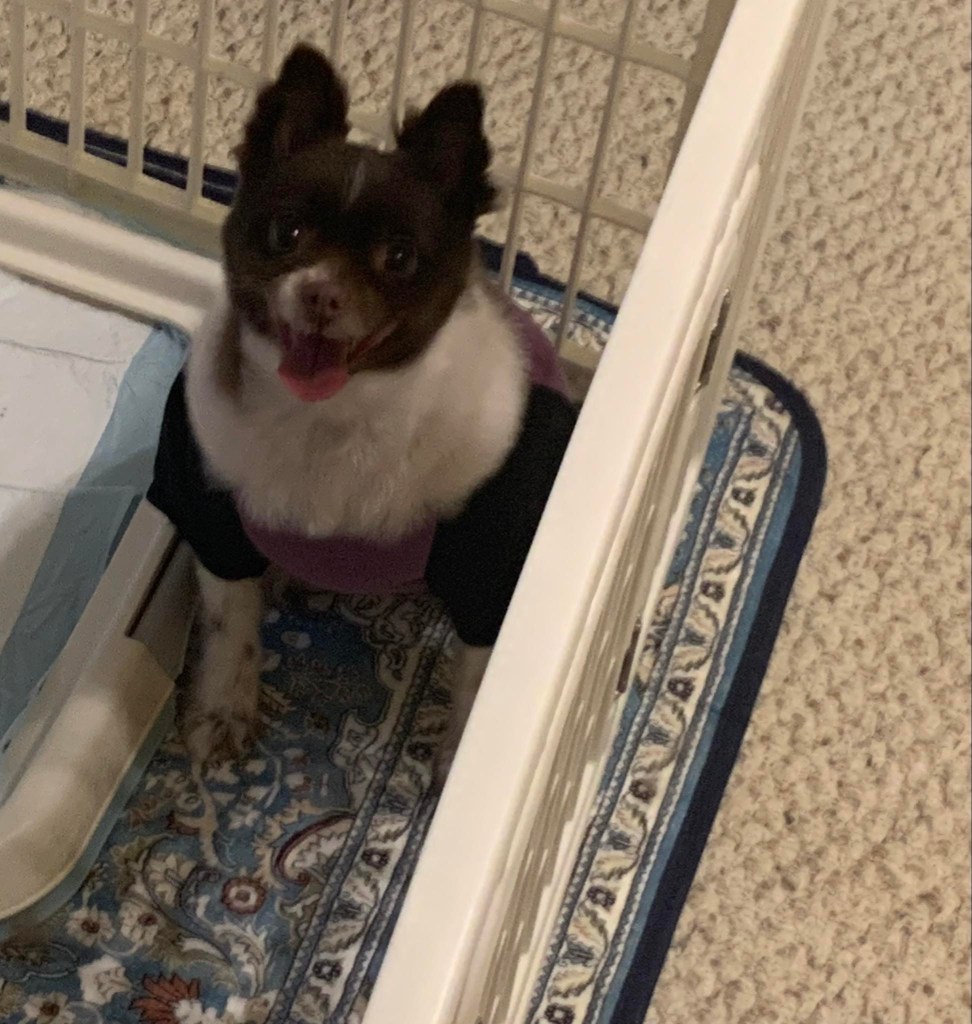
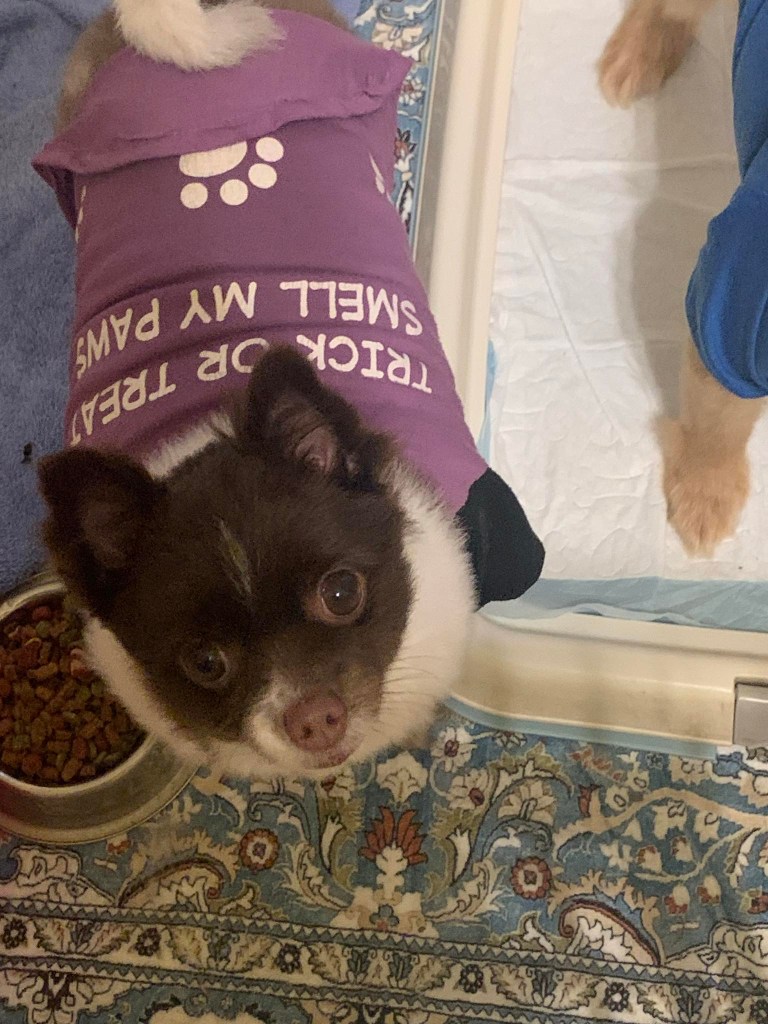
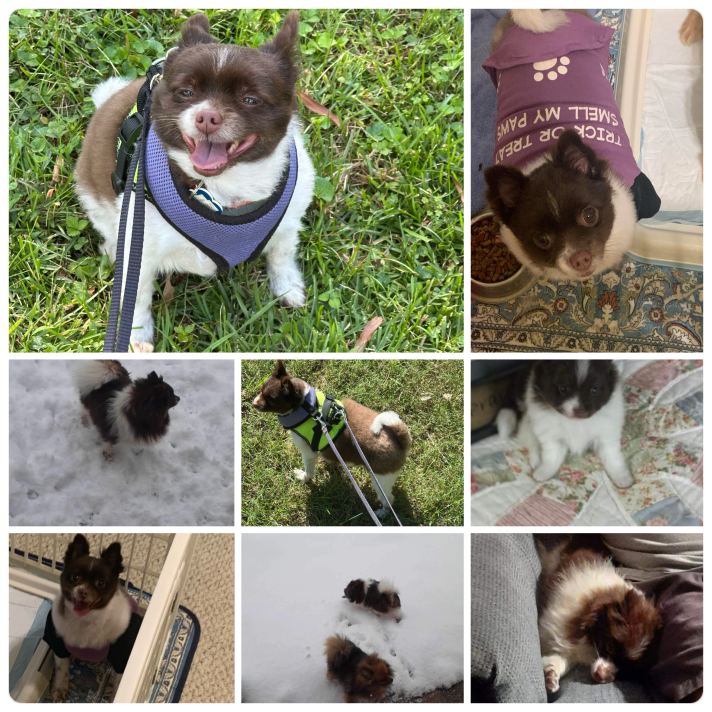
Truffles is a gorgeous, spayed, brown & white Beaver Pom. She is extremely loving and affectionate. If she had her way she would loaf around all day in your lap until it was time for bed. At night she is quite fond of spooning with her person. Sometimes I must push her away so I can move my legs to the other direction. LOL! She is chunky and needs to drop 1-2 pounds from her tiny frame.
Her personality is very quiet and gentle. She is a bit timid until she gets to know you.
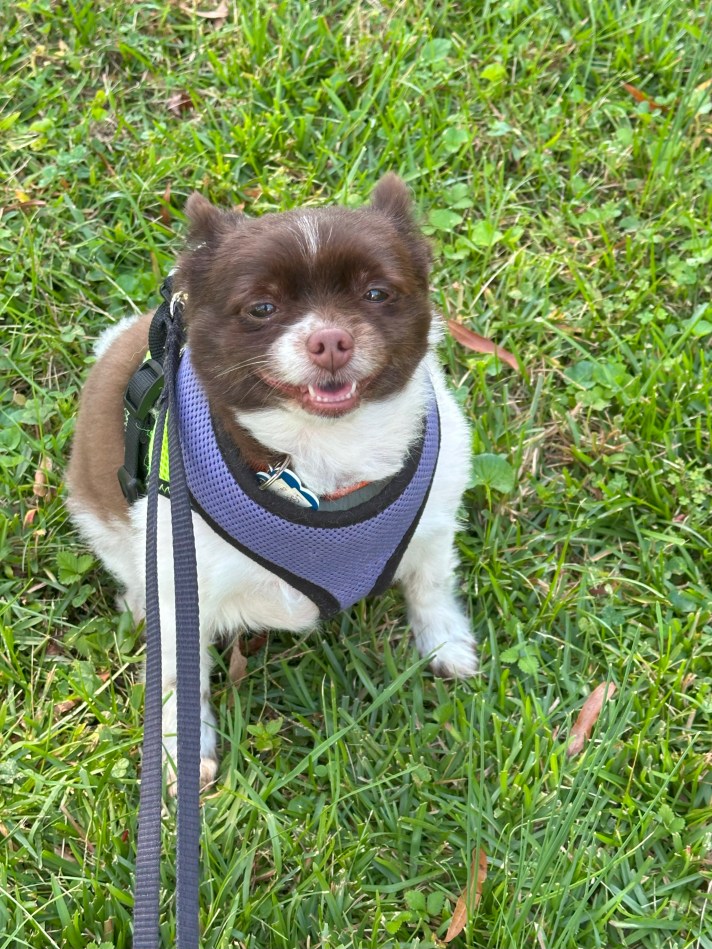
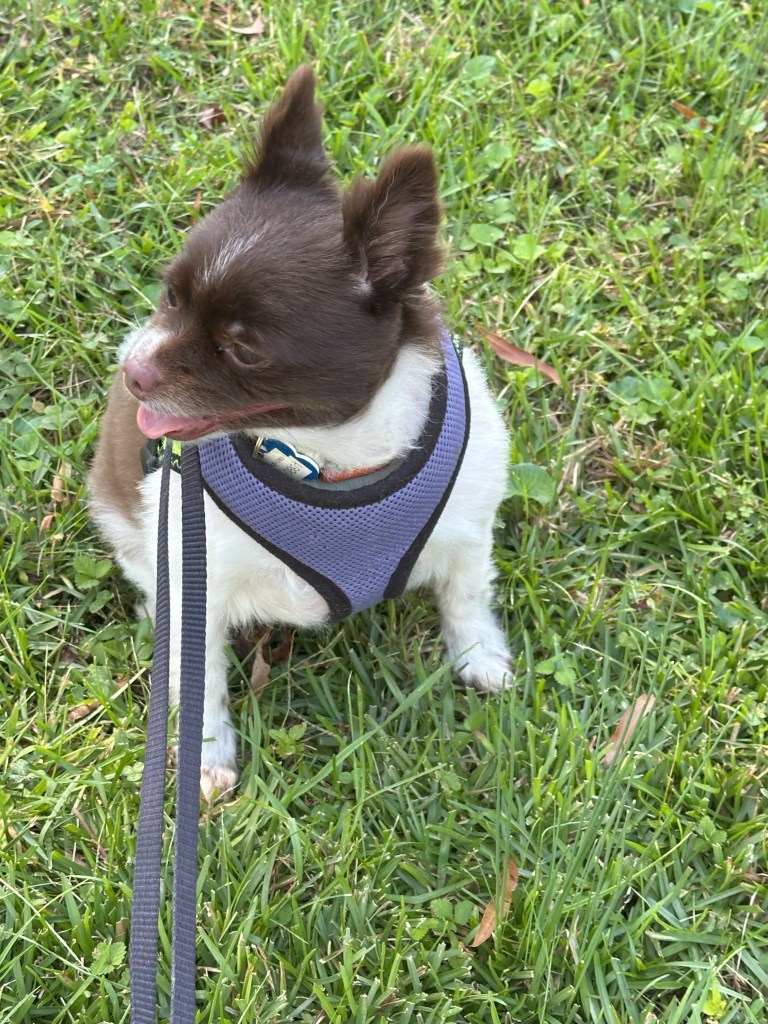
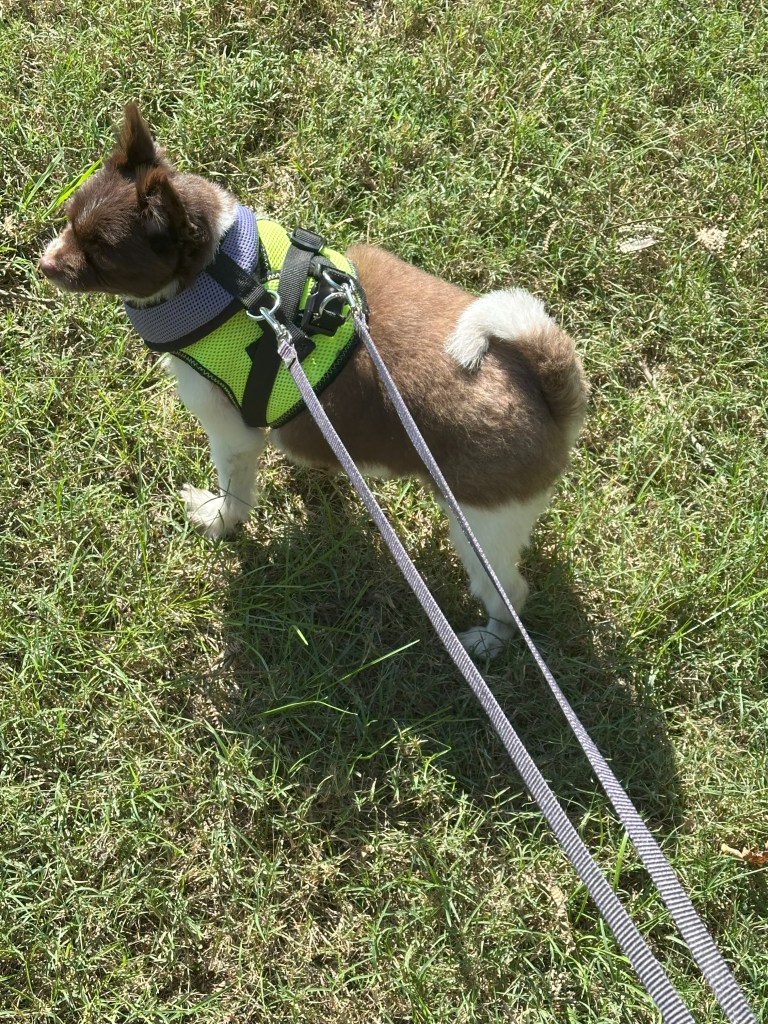
Truffles is learning her leash manners, but she is a Houdini and likes to slip out of her harness and run off on her own adventures. After the second time, we double-harnessed her as a precaution (see pic). That’s the first time we have ever had to do that. Luckily, she is very chunky so while she is fast out the gate, she doesn’t have much stamina.
After the first couple days, she didn’t try to get away anymore. I believe it was just a fear response because of all the changes. She is getting used to the harness and leash, but she doesn’t like to go for walks. She just plants her fluffy little butt down and looks at us like we are crazy to think she will walk with the other peasants.
She is quite smart. She figured out that we have a doggy door and how to use it without being shown. Usually, we have to show a newcomer the door and push/coax them through it a few times until they get the hang of it.
History
She is crate trained. Her previous owner says she is great with kids.
She was surrendered with her brother Bear. They were acquired during COVID and the son ended up being severely allergic. They tried multiple treatments and methods, but just couldn’t get his allergies under control. The family was devastated by having to make this agonizing decision.
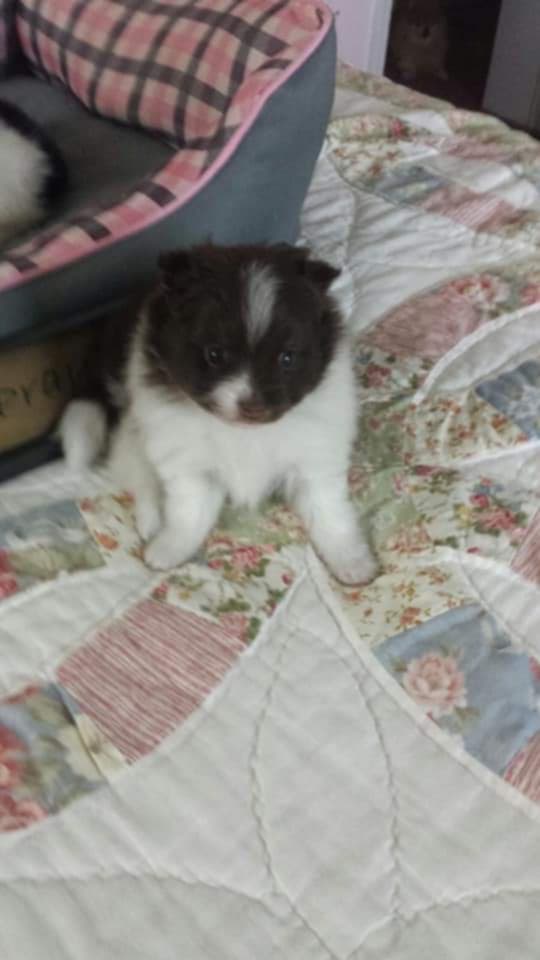
She was shaved down for summer, but it is growing back. You can see in the pictures she has a lovely coat when grown in. Since she is a beaver, her nose and eyelids are brown instead of the usual black which compliments her coat very nicely.
What does she need?
Truffles would do well with someone that loves to cuddle, doesn’t mind sharing their lap, but doesn’t expect to be slobbered with kisses. She gives kisses, just very demurely.
She needs a home that will work with her on her weight and get her into shape. She would be an excellent apartment dog.
We would love for brother and sister to be adopted together (a discounted adoption rate would apply). However, after evaluation, they are not a bonded pair and can be separated.
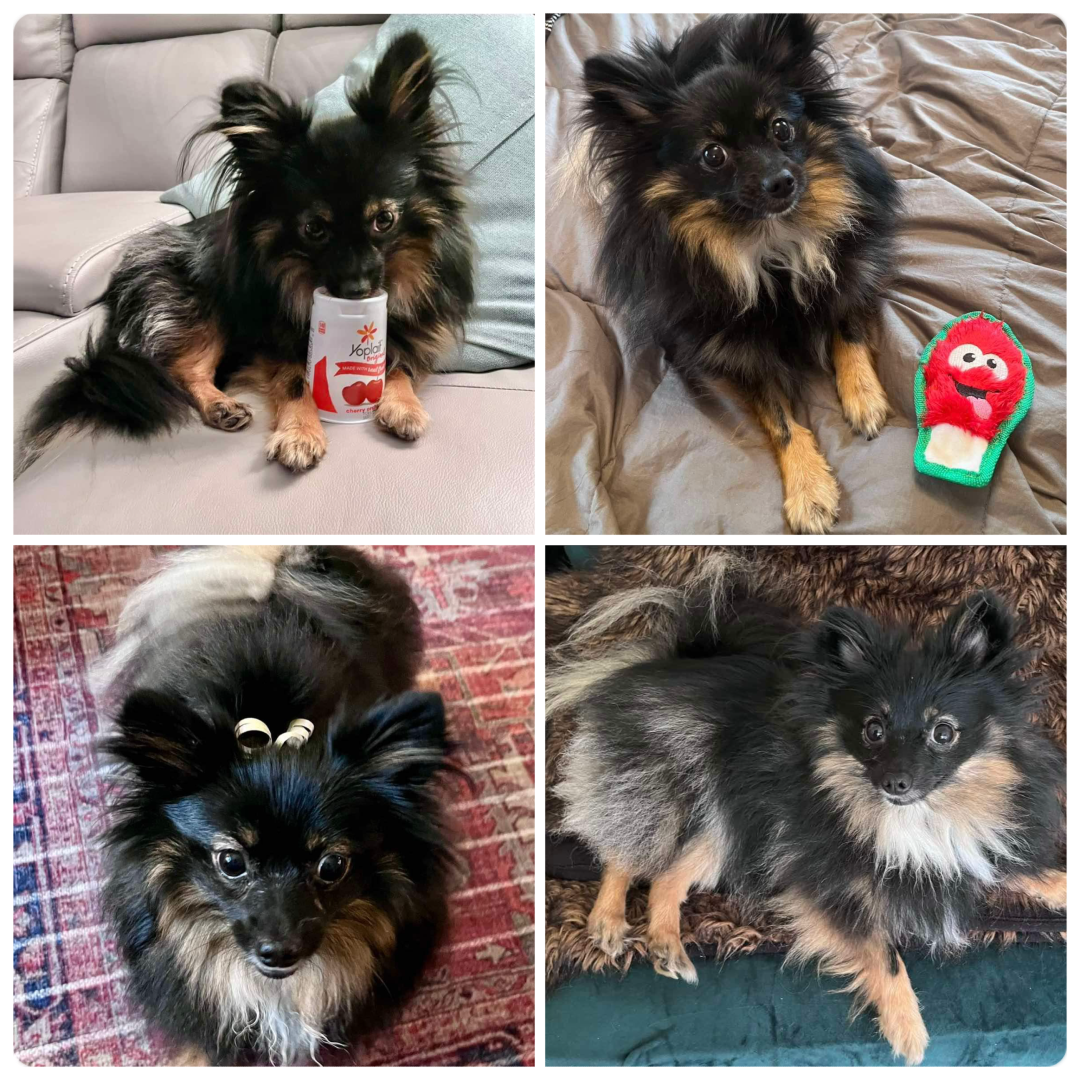
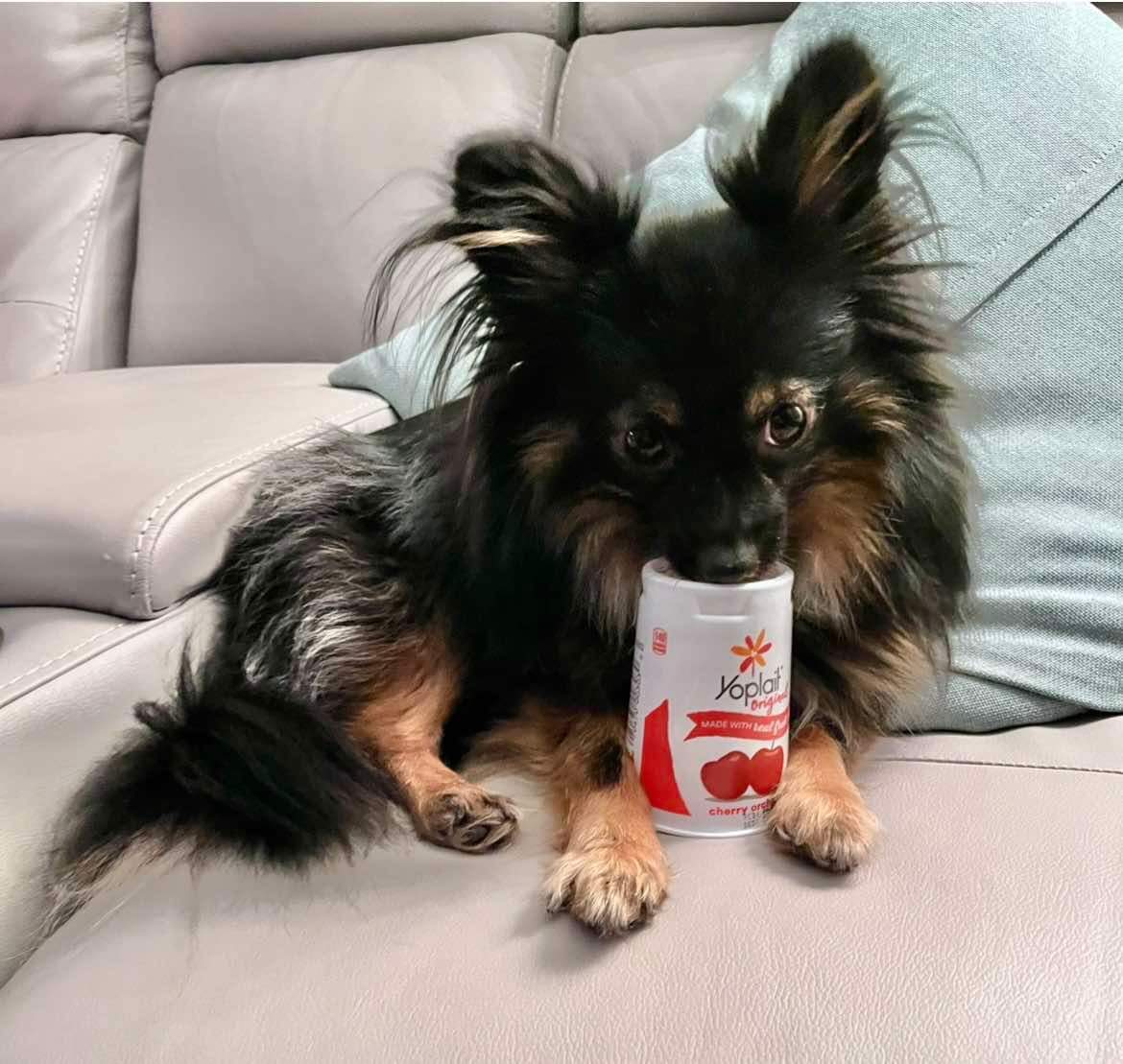
Demi is a pure bred (DNA Tested), 2.5 year old, 6 lb., Black and Tan girl with a super silky coat that you want to stroke for hours which is fine with her! She has been spayed, microchipped, and is up to date with all her vaccines including a 3-year rabies certificate.
Demi’s personality is super sweet. She loves being with her people, snuggling on the couch, or laying against your leg in bed. She loves going on walks and is ok on a leash. She tends to pull on the lead and could use some work on heeling. She gets along with other dogs, and we are told she loves to splash around in water. She would make a great therapy or agility dog.
History
Demi has had 3 homes in her short years through no fault of hers. Her first mom had her for a year but had to go into assisted living with no dogs allowed. Her second mom had her for a little over a year, but sadly, she passed away. Her daughter planned on keeping her, but she works full time and after 10 hours alone every day, Demi would work herself up so much she would make herself sick, so she made the heartbreaking decision to find her a new home more suited to her needs.
In September 2023 while playing with her mom’s grandson, she broke her rear leg in 4 places (ouch!). He had her in a sling and it sounds like she jumped out and landed on the concrete patio. It was surgically repaired, and you would never know it happened without an x-ray showing the hardware in her leg. She does like to jump up and down from the couch and recliner so stairs for the couch would be a recommended investment. Post-op she did have 2 seizures. This Is not uncommon with the small breeds as their blood sugar can drop very fast and appetites are often decreased immediately following surgery. She did see a neurologist and had a full work up that found no underlying cause. This would be something to make not of with your vet for future procedures (dental or other surgeries).
Grooming can be a challenge. She has allowed us to brush her a little, but we are told mani-pedi’s are a 2 person job. We had to clean her bum, and it took 2 of us.
When she was surrendered, we were told she was terrified of feet, but we have not experienced this. She follows me around the house right at my feet and lays next to them on the couch.
What does Demi need?
Most importantly, she must have a home where she is not left alone for long stretches of time every day. If you have a home where everyone goes to work/school every day, she is not for you. I think she would like another dog to play with also. She has tried to initiate play with our Poms, but they are 17 & 11 and don’t play much.
With her tendency to jump on/off furniture and follow around on your feet, young children are not recommended. Children over 12 would be okay as long as they understand how delicate Poms bones can be.
She seems equally interested in spending time with both my husband and me so she would likely be a great family Pom and not be attached to only one person.
I would really like to see her go to a family or couple under 65. She has already lost 2 moms due to old age in her short life. Poms expected life span is 14-16 years, so I would like her next home to be her last home.
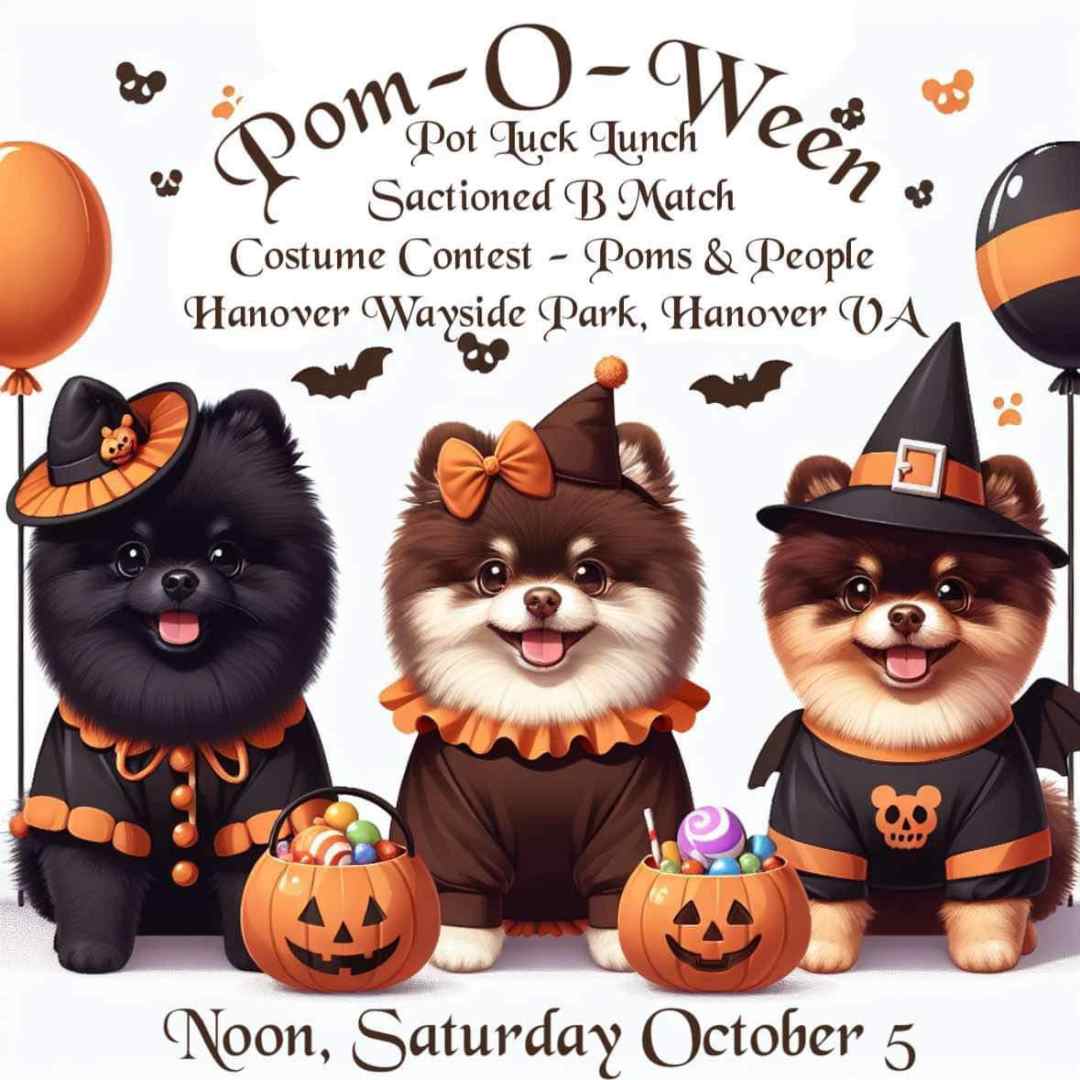
Come join us for Pomeranian Specialty Sanctioned “B” Match Potluck and Costume Contest on Saturday, October 5 at Hanover Wayside Park (click for directions) in Hanover/Mechanicsville, Virgina. We will be in shelter #2 complete with many picnic tables and electrical outlets. There is plenty of space to set up your grooming station and electrical outlets are available.
Check-in starts at 10:00 with the match starting at 11:00. Registration is $10.00 per Pom. The costume contest will take place after the match, owners are welcome to join their Poms dressing up.
Please feel free to bring something for the potluck (not required) and join us for lunch and talk to breeders and handlers about Pomeranians or just hang out.
If you have any questions, please feel free to post them in the event discussion on our Facebook page by clicking here: Happy Pom-O-Ween 2024
On hot sunny days asphalt, tarmac and pavements can become too hot for your dog’s paws, causing pain and burns, so at what temperature can you take your dog for a walk, how can you tell if the ground is too hot and what can you do to protect your dog’s paws from the heat?
Can pavements be too hot for dogs to walk on?
Yes, even on warm days, in certain conditions, pavements can become hot enough to cause pain, discomfort and even burn your dog’s paws. Although you may think your dog’s paw pads are quite tough, it’s important to remember that they are still made of skin and can be just as sensitive as the bottom of your feet.
Why do pavements heat up?
On sunny days, pavements can often be deceptively hot and will usually be much warmer than the air outside. Dark and dense pavements easily absorb heat from the sun and are good at keeping hold of it and releasing it slowly. Natural surfaces, including grass, tend to be much cooler, as plants release water to help cool themselves down.
How hot is too hot for dogs?
From just looking at the weather outside, or even feeling the air on your skin, it’s difficult to know how hot the pavement might be. The temperature of a pavement can be influenced by different factors, including:
Whether it’s in direct sunlight
How windy it is
Humidity
How do I know if the pavement is too hot for my dog?
The best way to tell if a pavement is too hot for your dog to walk on is to place the back of your hand on the pavement for seven seconds. If it’s too painful for your hand, then it’s too painful for your dog’s paws.
How do I know if my dog has been burnt?
When walking on a hot day, if you notice that your dog is limping, looking uncomfortable or whimpering, then look at the bottom of their paws and check the temperature of the pavement with the back of your hand. If your dog’s paws look red, swollen or blistered then it’s important that you quickly take them off the hot pavement and contact your vet for advice as soon as possible.
What do I do if my dog’s paws have been burnt on the pavement?
Putting your dog’s paws under cool, gently running water can help ease their pain, but if your dog’s paws are burnt from hot pavements then always speak to your vet for advice.
What to do on hot days and how to protect your dog’s paws?
On hot days try to:
Use the seven second rule to test the heat of a pavement and see if it’s safe for your dog to walk on
Try going for walks on cooler grass
Walk your dog in the early morning or evening
Avoid walking in the midday sun
Walking your dog at cooler times of the day in the summer will help to reduce your dog’s risk of burning their paws, but it also reduces their risk of developing heatstroke.
Storm season is upon us, which means that people all over the country are preparing their homes for hurricanes, tornadoes, floods, and more.
For many people, this means getting a “go-bag” ready, keeping your car stocked, and preparing just in case local authorities recommend evacuation.
If you’re in an area that requires evacuation a lot, you probably know exactly how to get yourself ready to go — but do you know how to prepare for evacuating with your pets?
Evacuating with pets is more complicated than just tossing them in the car and getting out of town.
Of course, taking your pet with you is the most important thing to do if a storm is imminent, but there are plenty of other things to do ahead of time if you think you might need to evacuate your home.
Evacuating can be overwhelming — both for people and for pets — so make the process as easy and painless as possible by following the tips below!
Pet Evacuation #1: ID Your Pet
The CDC explains that because disasters can occur without warning, you should always be prepared.
One of the most important things you can do is make sure that your pets’ collars and tags are up-to-date.
Their tags should have your current contact information, just in case you get separated from your fur babies.
Additionally, you should microchip your pet — this is the best way to guarantee you’ll be reunited with your pets if they get lost.
Pet Evacuation #2: Snap A Current Photo
According to Ready.Gov, you should always have a current photo of your pet in order to identify them if necessary.
This won’t be a problem for most pet owners (as we take photos of our pets nonstop), but make sure you have one that doesn’t just capture how gosh darn cute they are, but also shows their defining features.
Pet Evacuation #3: Secure Your Pet
Before an emergency, purchase a pet carrier for each of your fur babies — then write your name and contact information, along with your pets’ names, on the carriers.
When you purchase the carrier, get your pet familiar with it, and practice transporting them in the carrier before an emergency. This will make them more comfortable with being inside the carrier during an evacuation situation.
You should also make sure you have extra leashes and harnesses to keep them safe while they’re outside.
Pet Evacuation #4: Identify Shelters
Not all shelters set up for humans are able to take pets, so if you plan to stay at a shelter when you evacuate, make sure you find one that is okay with pets.
The same goes for hotels — if you are going to stay in a hotel or motel during evacuation, find one that allows pets to stay as well.
Ready.Gov explains that although it should be a last resort, some animal shelters will provide temporary housing/foster care for pets that cannot be with their humans during times of evacuation.
Pet Evacuation #5: Coordinate A Backup Plan
No matter what you are planning on doing with your pet when you evacuate — boarding them, leaving them at a shelter, or taking them with you — make sure you have a backup plan.
Talk to your friends, family, and neighbors about what they’re doing with their pets, and see if you can help one another out with evacuation.
In case of emergency situations, you may not be able to get home before evacuating — the ASPCArecommends having designated caregivers (who hopefully live nearby) who are comfortable with your pets and willing to care for them in a time of need.
Pet Evacuation #6: Separate Dogs And Cats
Ready.Gov explains that pets can sense when something is wrong, and it may cause them serious stress and anxiety.
Even if your dogs and cats are normally fine together, the stress of the situation may cause them to act irrationally, especially if they are in confined spaces.
For this reason, separate your cats, dogs, and other pets when you’re evacuating (or anytime during an emergency situation).
Ideally, every animal should go in a separate crate or carrier until you can get them to a calm, safe place.
Pet Evacuation #7: Prepare A Pet Emergency Kit
Many people have human emergency kits and “go bags” with necessary items, but it’s important to have them for pets as well.
Pet emergency kits should include enough food and water for two weeks, food and water bowls, medical records and any medications, poop bags, kitty litter, and other clean-up items, and any comfort items your pet might need (like a bed, blanket, or toy).
Pet Evacuation #8: Get A Rescue Alert Sticker
The ASPCA recommends that everyone have a rescue alert sticker near the front door of the house in case of any emergency. The sticker should include information on any pets that live in the house.
A rescue alert sticker can help in case there’s ever a fire or floor at your house so that first responders know to save your pets, but it can also be helpful during an evacuation situation.
If you have a rescue alert sticker and you evacuate your home, write “EVACUATED” on the sticker so that rescue workers know they don’t need to search your house for pets.
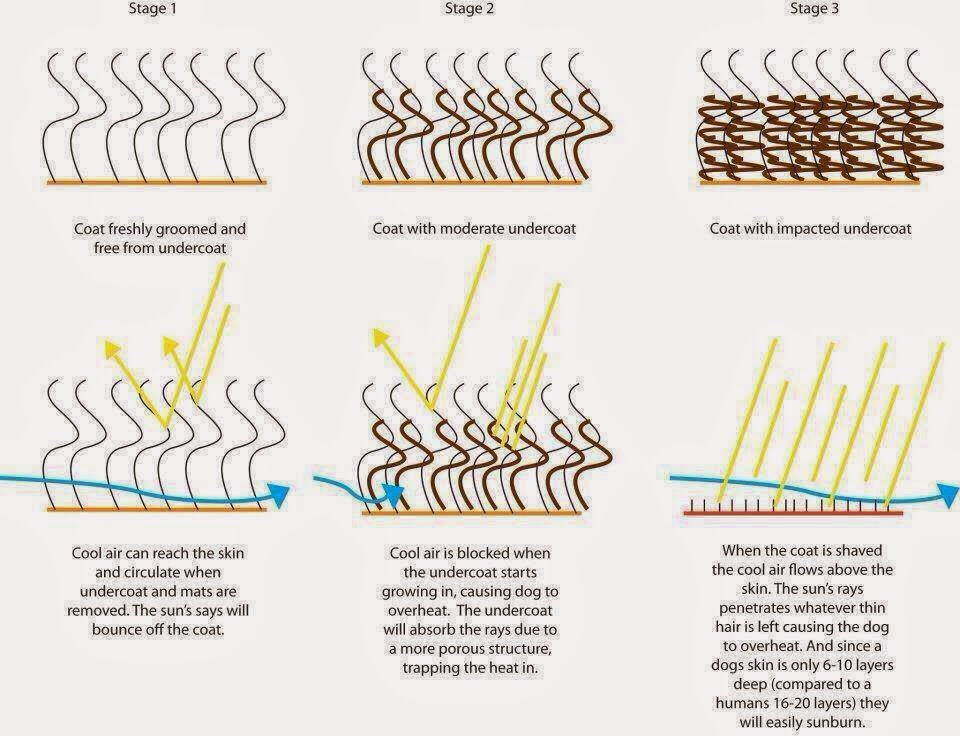
Double coated dogs refer to the animals that, like Huskies, have two layers of fur. The first, or undercoat, are the fine, fluffy hairs that are short and crimp (closest to the skin). It’s the fur that sheds; light and soft. This layer is excellent at trapping air and insulating the dog. Essentially it keeps them warm in the winter, and cool in the summer. The topcoat is made up of tougher guard hairs that don’t shed, and protect your pet from the sun’s harmful rays and bug bites. It actually insulates them from the heat. What this means is: do not shave your double coated dog. It’s a mistake to think you’re helping your animal stay cool, particularly in summer, when evolution has provided them exactly what they need to survive. By stripping them of their natural ability to heat and cool themselves, you could be doing more harm than good.
A key piece of understanding in this matter is that, unlike humans; dogs do not cool themselves through their skin. At most, it is only the pads of their paws that sweat. Their main mode of cooling comes from panting.
Some other common reasons folks shave their doubled coated dogs are the thinking that the animal will stop shedding. Pooches with undercoats shed, no two ways about it. But even after a shave, while the hair may be shorter, it can still shed.
Another is, “it’ll always grow back”. Sometimes it will, other times it won’t. The older the pooch is, the less likely it is that the topcoat of guard hairs will grow back. This leaves them with the undercoat, giving them a patchy, scruffy look. It can alter their coat for the rest of the dog’s life.
Not only does it look bad, but you can end up having to shave the hair continuously from then on and once again, you strip them of their natural ability to protect themselves. In conclusion, when you shave a double coated dog, you may irreparably impair their ability to properly heat/cool themselves and protect their skin. The best way to keep this kind of dog cool and comfortable is to regularly bathe and brush them. The only reason a person might need to shave their double coated dog is if the hair is so matted, it’s the only option.
Bailey – one year after being shaved. This is all the growth that returned. He is brushed and poofed up here. His coat is patchy and his guard hairs are non-existent. He was only shaved once by necessity.
Romeo was shaved a few times from ages 4-6. He is now 10 and has a wonderful coat.



:max_bytes(150000):strip_icc():format(webp)/__opt__aboutcom__coeus__resources__content_migration__mnn__images__2014__06__paws-parts_0-07e021a2e3904ec3a956c32a955424cb.jpg)
:max_bytes(150000):strip_icc():format(webp)/GettyImages-1144580161-e70991a2415d46608aeb91e43acc3ad5.jpg)
:max_bytes(150000):strip_icc():format(webp)/1398px-Owczarek_francuski_beauceron_wilczy_pazur_z_bliska-0a66a8c28d304705acdda97539ce018c.jpg)
:max_bytes(150000):strip_icc():format(webp)/212041830_ba553388d6_b-8871ece4306e40d199bf2334118531e5.jpg)