ADOPTED 7/5/14!!! – CASPER (Central Virginia)

Casper has been with us since Father’s Day weekend and is one of the most loving rescues we’ve had.

His idea of a perfect day is doing anything you are doing as long as he is doing it with you.  Be warned!  Once you roll him on his back for belly rubs, you better be in for the long haul.  He can stay like that for what feels like an eternity just letting you gently caress his belly.  He enjoys sleeping at your feet in bed and snuggling on the couch.  He does very well on the leash and adores car rides. One mention of his name and he is by your side before you can blink!

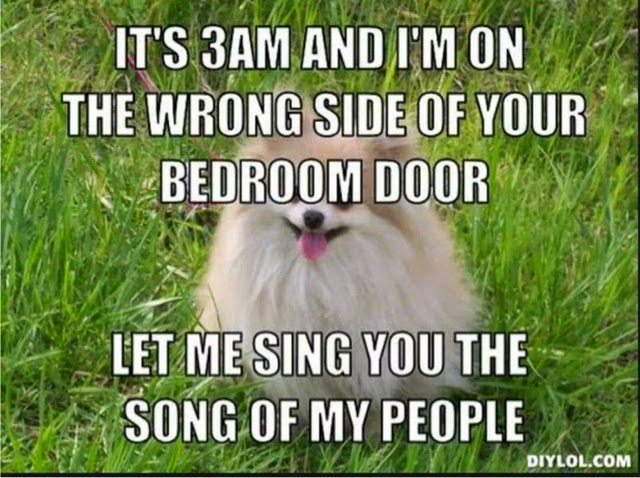
Casper is a gorgeous cream color, and weighs in at a healthy 6.9 pounds.  He just turned 5 in May so he still has a decade left in him to be someones companion.  His previous owners did not take care of his teeth which led to overcrowding from adult and baby teeth that had not fallen out, so we had to have 23 teeth pulled.  As a result, he does not have any front teeth to keep his tongue in his mouth, so it sticks out a little (which is quite adorable).  However, that is not as bad as it may sound.  He still retains his back molars so he can chew small bites kibble and would do well on a mixed diet of kibble and soft food.

He tested negative for heart worms and has a very strong heartbeat with no signs of murmur and great patellas.  He has recently been neutered and had all of his shots updated.  He did experience quite a bit of post surgical pain which led to him not being able to stand up 2 days after surgery.  Our vet changed his pain medication and he is now doing fine and is able to go to a new home.  In the future, his vet should be made aware of this if he is to have any procedure done as this is not a typical response.

When he arrived he did have 2 ticks on him (one in his ear canal).  He tested with a very faint positive for Ehrlichia & Lyme and had had ear infections in both ears.  He has received medication for the ear infection and has not shown any symptoms for Ehrlichia or Lyme requiring treatment.  This indicates the positive results were most likely caused by the toxins from the current ticks and will have completely worked out of his system in few weeks.

He has a curious habit of leaning a bit to the left.  His tongue sticks out to the left.  When you hold him, he relaxes to the left.  He has a tiny hitch in his step (that has improved after treating his ears), which gives him a different gait than your usual Pom.  Our vet examined him and feels this is likely due to a previous unknown injury.

Casper’s Adoption Fee is $300.

Keep checking back as new pictures get added to the slideshow regularly!

Click Here to Complete an Adoption Application

Click Here to Sponsor Casper and Help with Vet Costs

Spring is here! Time to put the top down!

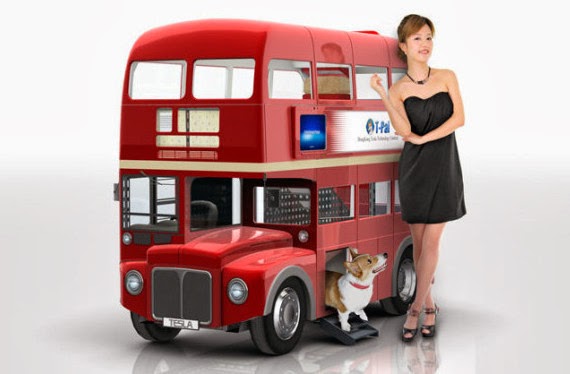
Forget the Smart Home, This Is the Smart Dog House | Chip Chick

The top floor of the London-style double decker bus get-up has a tablet that can be loaded up with music, movies and games. (which says a tremendous amount about the state of mobile gaming). Owners will also be able to initiate video calls with their dog, if the owner is off at work and starts having separation anxiety. Next to that tablet, there’s a smart food dispenser that can be put on a schedule. On the other side of the floor, there’s a heated bed that will also wirelessly charge the dog collar that keeps track of your dog’s location, should your dog escape the townhouse/prison it’s holed up in.

On the bottom floor, there’s a toilet of sorts. This area gives off a scent that attracts dogs when they need to relieve themselves . Once that business is done, the toilet area will automatically flush, with the waste going down into a chamber, where it is broken down and sterilized. “

To read the full article and see the video, click below:

Forget the Smart Home, This Is the Smart Dog House | Chip Chick:

iFetch – so your dog can play fetch by themselves! Made for small or medium dogs, perfect for our Pommies!

This looks awesome if you have a ball obsessed fur baby in your home.  

What makes this look even more wonderful is that it uses miniature tennis balls as opposed to full sized ones!  Finally, a product that realizes our little ones like to play fetch too!  Just because they play with little balls, doesn’t mean our arms don’t get tired throwing them, especially when more than one dog is involved.  And let’s face it, with Poms, nobody can own just one!

Speaking for our rescues, we have had some very playful rescues this past year that would definitely found this entertaining.

A couple of features mentioned in the article that really made my ears perk up:

  • iFetch is designed for INDOOR use
  • uses miniature tennis balls 
  • can adjust to throw either 10, 20 or 30 feet
  • auto power on and off
If I ever get my hands on one, I will post a proper review here and on our FB page.  

In the meantime, we would love to hear your thoughts by commenting below.


Click here for an article on Dogster

Nervous Dog Magazine

Happy Valentine’s Day

First thing I see in the morning

Can you tell us where you were all day?

My Pomeranian Helps Kids Learn to Read

Meet my dog, Jazzi. She helps kids learn to read. She’s what’s known as a Tail-Waggin’ Tutor. Jazzi is a 2-year-old Pomeranian. She is smart, extremely obedient, gentle, calm, and most of all exceptionally sweet. She is also unbelievably childlike in her manner. In the comfort of her own home, she is a lap-hopper and an ear-licker. She is the ideal dog for helping kids.
To help get her there, when Jazzi was 6 months old, I trained her to be a therapy dog. To qualify a dog must be at least a year old. I already had this experience with my other dog in this same field, so training her myself was easy. When Jazzi’s day came to take her Canine Good Citizentest, I got her tested as a therapy dog at the same time. During the exam, I was more nervous than she was; I had to keep reminding myself not to transmit my nervousness down the leash to her. But Jazzi had no problem passing both her Therapy Dogs International and CGC tests. I am now her personal handler and we are a team. She is so docile, and such a sweet pup. The instructor testing her wrote that very comment on her test paper. (I was not surprised.)
To read the full story, CLICK HERE

5 Tips for Caring for Senior Dogs

Click here for the full article:  Dogster – Caring for a Senior

1. Scale back exercise

We are big on exercise, for ourselves and for our dogs. Our dogs have always run with us at least three to four times a week and then been walked on the off days. As your dog gets older, the amount of activity should be scaled back to accommodate natural aging as well as any orthopedic issues or arthritis that may develop. Several shorter walks are better than one long one. Skipping days is also an option. Playing fetch may be another area where you may need to scale back. Dogs will let you know when they are tired.
 
Follow your dog’s lead and make sure you adjust appropriately. In addition, try other low impact exercise options for your senior, including swimming and balance/core exercises, even Pilates.

2. Adjust nutritional needs

Dietary adjustments should be made as your dog’s nutritional requirements change. Your dog’s digestive system is aging and your dog may not be able to digest the same types or volumes of foods she did when she was younger. We switched all of our dogs to a senior food diet around age eight. It’s usually a bit lower in calories, and since we have Labs, weight is always a concern. If you feed your dog treats or table scraps, be more careful about what you give them. Maggie has had a couple of her teeth pulled, so she can’t chew on hard bones or treats — she prefers the softer ones. Again, watch your dogs’ behaviors and take cues from them. If they are leaving things uneaten, or are taking twice as long to get through something they used to gobble up, you might want to rethink and adjust.

3. Start annual vet checks, and watch for signs of trouble

Most vets suggest an annual senior checkup once a dog reaches age eight. They do a blood panel, urinalysis and exam, checking on all the basic bodily functions. Your vet will keep records of their weight as well as the lab results that show how their internal organs are performing. Older dogs tend to develop lots of lumps and bumps. Usually they are simple lipomas (a simple fatty lump), but sometimes they can be more significant lymphomas or mast cell tumors. Any new lumps you detect should be checked by your vet immediately. Labs have a tendency towards these fatty lumps, but our vet keeps a record of the ones that have been checked to help defray the expense.
You also want to watch for shortness of breath, fatigue, upset stomach or changes in bathroom habits — the same signs you watch for in an elder human. Know the hereditary diseases your breed of dog may be susceptible to and what the symptoms are so you can catch potential problems early. Follow your instinct and check with your vet if you are suspicious. 

4. Don’t overlook rehabilitation — and even prehabilitation

Like humans, dogs benefit from many different rehabilitation modalities. There are more and more canine rehab and physical therapy facilities available these days, such as water treadmills, electrical stimulation, laser therapy, and exercise modalities using balance balls. Labs have a tendency towards orthopedic problems, and Becca, being a service dog who carried a pack, had severe spinal issues. We have used rehab/prehab to help our older dogs recover from injury, as well as prevent injuries from occurring in the first place by building strength. Being Labs, they love the whole water treadmill idea, and Becca used to play fetch while on the treadmill! We’ve also used acupuncture for pain relief and arthritis.

5. Watch for changes in your dog’s mental state

Yes, there is such a thing as doggy dementia. Our dog Tino, who passed when he was almost 15, developed dementia. He was blind from age nine, so at times it was hard to tell whether it was due to the blindness or the dementia when he was acting weird, but as he aged there were noticeable indications. Dementia signs to watch for include a sort of restlessness or agitation, circling the room, circling in place, and disorientation. Your dog might forget where he is or where he is going — and maybe even forget who you are.
 
Tino would frequently get stuck in corners or behind furniture — and this was one of those areas where his blindness certainly didn’t help! Loss of bowel and bladder control is frequently observed, so be prepared to purchase with some doggy diapers (yes, they have those). These developments can be disturbing to some people. I will be honest and admit that Tino’s declining mental state was a contributing factor in our decision to finally euthanize him. The good news is that there have been many developments and advancements in recent years in treating canine cognitive dysfunction, so be sure and discuss these options with your vet.

Dogs in Heaven

Cash back on all purchases for Pom Rescue! It’s FREE

Remember as you do your shopping this Christmas, that if you use the Adopt-A-Shelter Pomeranian Club of Central Virginia’s shopping portal, then a percentage of everything purchase gets sent to the PCCV to aid in Pom Rescues!

It’s totally FREE!!!  NO Signup!  No logins!  You don’t have to create an account.

All you have to do is click a link to the store you want to shop at.  The link tells the store that you are shopping using Adopt-A-Shelter and they will automatically send a portion of your purchase to us.  Some stores donate as much as 6% of your purchase!!!

Look at #3 on our How to Help page for more details and example of how to do this everyday, or if you are ready to start shopping,


Here is a sample of stores that participate:

7 Reasons Senior Dogs Make Great Adoptions

Dogster – Reasons to Adopt a Senior

1. They’re economic stimulus hounds

Because seniors are among the last to be adopted at animal shelters, adoption fees are often significantly reduced. Talk about an adopter’s incentive: With the money you save, you can spring for, say, premium dog food or a couple of fun toys.
If, like me, you work at home, a senior canine (or a couple) makes the best company, lowering your stress so you can get the most out of a day’s work. Dozing patiently by your desk, they’ll help you remain calm — and that’s great for productivity.

2. They cure empty-nester blues

What better distraction for a lonely parent whose child just left for college than a sweet senior dog? Tabatsky is counting on it when his time comes: “As soon as my daughter graduates high school next year and joins her brother in that elite club of 18-year-olds leaving home, I plan to adopt a houseful of dogs, preferably older and wiser, who will understand my empty space and enjoy filling it as lovingly as possible.”

3. They help you let go of the fear of letting go

Some folks fret about getting attached to a senior dog, then losing them not long after adopting them. Please have no fear! The first dog of my adulthood, Daisy the Pit Bull, was about 6 when I adopted her. We enjoyed eight lovely years together, and I wouldn’t trade that time for anything. I’ve also adopted superannuated seniors who’ve spent a year or less with me; but again, even that short time together was so worth it. Even in a short span of time, the love you give a senior — especially one who was previously neglected — is a beautiful thing, which will enrich not just the dog’s life, but yours, too.

4. They help reverse the clock, for the dog and yourself

Many adopters fear, wrongly, that a senior dog will have lots of health issues. And even if a dog has one or two issues, I’ve found that with TLC plus the right dietary and nutritional-supplement choices, a senior dog can take one last dip in the fountain of youth.
I fostered one hot mess of a senior Maltese who was overweight, with cloudy eyes and bald patches. I fed her wholesome food in strict portions; supplemented her diet with quality food, vitamins, coconut oil, herbs (milk thistle for those eyes, hawthorn for her heart), and spices; and bathed her in Neem oil. After a few weeks, little Sasha looked so youthful, no one believed she wasn’t a youngster. You can reverse your own clock by trying the same nutritional regimen.

5. They make dog walks slow and steady

Seniors’ slow gait means you can enjoy relaxed strolls instead of power-walks — plus more quality off-leash time, even in unfenced, outdoor areas where you’d never trust a young, hyper dog.
My sweet Border Collie, Sheba, used to love ambling along off leash on the grassy (or, in winter, snowy) knoll that is the parkway near our home. Despite traffic whizzing by in opposite directions on either side, I knew I could trust my wise old girlfriend not to make a mad dash under an oncoming car. Of course, for safety’s sake, I never let her out of my sight.

6. They’ll surprise you

Don’t think just because a dog is older she won’t astonish you with bouts of youthful vigor and high spirits. At age 13, Sheba took a young male pup named Piggy under her wing; their relationship was so tender, affectionate, and playful.
It was a joy to behold them frisking about, especially when Piggy would push his food bowl in Sheba’s direction in the ultimate gesture of hospitality. In the twilight of her life, my old gal found herself a sweet, handsome, younger beau — which ought to give us all hope that it’s never too late!

7. They really do learn new tricks

Honest! All the senior dogs I’ve known have taken major life changes in stride. I’m convinced their adaptability, not to mention their eagerness to experience new phenomena and make new friends, can keep them youthful to the end. Sheba was young at heart right up to the day she passed away.

Time to order your 2014 PCCV Calendar


Guess what time it is?  It’s time to place your order for the 2014 Pomeranian Club of Central Virginia calendar!

Calendars are $10.00 each + $2.00 for S&H 
Add .50 S&H for each additional calendar.  

There are 3 ways to order!

1.  Contact any PCCV member and arrange to pick up,

2.  Mail a check/MO to Barbara Corson to have shipped,

3.  Finally, you can submit payment by credit card via the Paypal “Donate” button on the right.  If using Paypal please add .50 cents for their fees.

All proceeds go to the Pomeranian Club of Central Virginia