1. What’s in a Paw?
Of the 319 bones, on average, that comprise a dog’s skeleton, a handful of those (so to speak) are dedicated to the paws. Along with bones, dog feet include skin, tendons, ligaments, blood supply, and connective tissue.
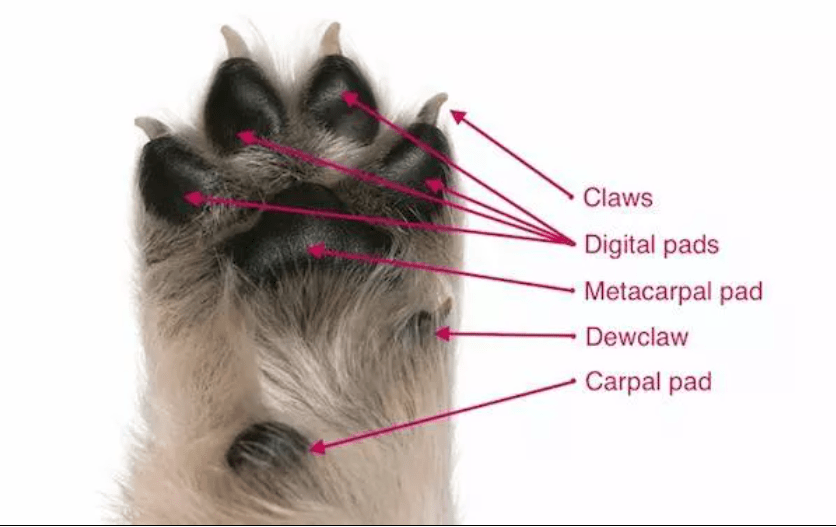
Paws are made up of the following five components: Claws, digital pads, metacarpal pads, dewclaws, and carpal pads, as illustrated below.
:max_bytes(150000):strip_icc():format(webp)/__opt__aboutcom__coeus__resources__content_migration__mnn__images__2014__06__paws-parts_0-07e021a2e3904ec3a956c32a955424cb.jpg)
Eric Isselee / Shutterstock / Treehugger
Pads
3. The digital and metacarpal pads work as shock absorbers and help protect the bones and joints in the foot. The carpal pads kind of work like brakes, and help he dog navigate slippery or steep slopes.
4. Paw pads have a thick layer of fatty tissue, but that doesn’t mean your pooch can’t sustain an injury from walking on a surface that’s too hot or cold.1 Scientists believe that domestic dogs first evolved in colder environments before spreading out into other climates.2 The thick pads allow dogs to develop a tolerance to temperature extremes. However, in cold weather, dogs can suffer from cracked or bleeding paws and in hot weather, walking on hot sand or sidewalks can cause their paws to blister.
5. The pads also offer protection when walking on rough terrain.3 Dogs that are outside a lot and exposed to rough surfaces have thicker, rougher paw skin; dogs that stay in more and walk on smoother surfaces have softer pads. The pads also help the dog distinguish between different types of terrain.
:max_bytes(150000):strip_icc():format(webp)/GettyImages-1144580161-e70991a2415d46608aeb91e43acc3ad5.jpg)
mikroman6 / Getty Images
6. The inner layer of skin on the paw has sweat glands, though they are not effective in cooling a dog on a hot day. You might notice paw prints as your dog’s paws exude moisture; dogs get sweaty hands, just like humans do.
Toes
7. Dogs are digitigrade animals, meaning that their digits—not their heels—take most of their weight when they walk.4 Because of this, dogs’ toe bones are very important.
8. Dog’s toes are equivalent to human’s fingers and toes, although they are unable to wiggle them with the ease that we do.
Dewclaws
9. Dewclaws are thought to be vestiges of thumbs.1 Dogs almost always have dewclaws on the front legs and occasionally on the back. Front dewclaws have bone and muscle in them, but in many breeds, the back dewclaws have little of either. Because of this, dewclaws are often removed to prevent them from getting snagged. (However, opinions on the necessity of this procedure are mixed.)
10. Although they don’t provide very much function for traction and digging, dogs do use their dewclaws; they help the dog get a better grip on bones and other things the dog may like to chew on. Front dewclaws also provide traction when dogs are running at high speeds.
:max_bytes(150000):strip_icc():format(webp)/1398px-Owczarek_francuski_beauceron_wilczy_pazur_z_bliska-0a66a8c28d304705acdda97539ce018c.jpg)
Pleple2000 / Wikimedia Commons / CC BY-SA 3.0
11. Great Pyrenees still use their rear dewclaws for stability on rough, uneven terrain and often have double dewclaws on the hind legs. Among show dogs, the Beauceron breed standard is for double rear dewclaws; the Pyrenean shepherd, briard, and Spanish mastiff are other breeds that have double rear dewclaws listed for show standards as well.
Shape and Size
12. Breeds from cold climes, like St. Bernards and Newfoundlands, have wonderfully large paws with greater surface areas. Their big, floppy paws are no accident; they help these breeds better tread on snow and ice.
13. Newfoundlands and Labrador retrievers are known for their long toes. Both breeds also have webbed feet, which helps make them excellent swimmers. Other breeds with webbed feet include the Chesapeake Bay retriever, Portuguese water dog, field Spaniel, and German wirehaired pointer.
14. Some breeds have what are called “cat feet.” These dogs have a short third digital bone, resulting in a compact feline-like foot; this design uses less energy to lift and increases the dog’s endurance. You can tell by the dog’s paw print: the prints of cat feet are round and compact. Akita, Doberman pinscher, giant schnauzer, Kuvasz, Newfoundland, Airedale terrier, bull terrier, keeshond, Finnish spitz, and Old English sheepdog all have cat feet.
:max_bytes(150000):strip_icc():format(webp)/212041830_ba553388d6_b-8871ece4306e40d199bf2334118531e5.jpg)
Marianne Perdomo / Flickr / CC BY-SA 2.0
15. On the other hand — er, paw — some breeds have “hare feet,” which are elongated with the two middle toes longer than the outer toes. Breeds that enjoy hare feet include some toy breeds, as well as the Samoyed, Bedlington terrier, Skye terrier, borzoi, and greyhound. Their paw prints are more slender and elongated.
Paw Odor
16. And then there’s “Frito feet.” If you notice the distinct smell of corn chips emanating from your dog’s paws, resist salivating. Sometimes the aroma is due to bacteria and fungi, but generally, the odor doesn’t lead to complications for the dog.
Massage
17. Do you love having your hands massaged? So does your pup. A paw massage can relax your dog and promote better circulation. Try rubbing between the pads on the bottom of the paw, and then rubbing between each toe.
Etymology
18. “Paw” comes from the early 14th-century paue, meaning “hand or foot of an animal which has nails or claws,” from Old French powe, poue, poe “paw, fist,” a word of uncertain origin.
https://www.treehugger.com/things-you-didnt-know-about-dog-paws-4864204